27 Jan 2026 • 5 Minutes Read
Written by Elore Digital Team
Customise your Advertising Web Banners to Boost your Business by Following these Simple Steps!
Customise your advertising web banners with the right design, targeting and visuals to increase engagement, improve CTR and drive more leads.
The use of a creative rectangular graphic display or ad that extends across the top, bottom or sides of a website or other online media property is known as banner advertising.
To put it simply, banner advertising is a type of creative digital advertising
Why do you Need a Banner Ad?
On web pages, banner ads are placed in high-traffic areas to raise brand awareness and generate clicks, purchases and leads. The main aim of banner advertising is to boost and stimulate a brand's awareness and overall brand consideration among the locals as well as encourage viewers to visit the brand's website and generate more clicks. Banner ads can be helpful in meeting a brand's business goals.
Evaluation of Banner Ads?
CTR, or click-through-rate, is an important factor to consider when evaluating the efficacy of banner advertising. The click-through rate metric is calculated by dividing the number of clicks an advertisement receives by the quantity of impressions it received or the amount of time the ad was shown. Therefore, a banner ad's effectiveness may increase with increased CTR. Brands might examine the results of previous campaigns or other information to raise click-through rates.
The better the CTR, which typically hovers around 0.1% for display ads.
According to the most recent statistics acquired from the Bannerflow platform, the average CTR for feed-based display advertisements (personalised ads) is currently 2.30 percent greater than the CTR for non-feed ads in 2022. This is an increase from the 2021 rate of 1.68%.
Source: Bannerflow.
Banner Ad Sizes for Targeting Viewers:
Knowing the required banner ad sizes is essential, but it shouldn't be your only concern. We have some tips you should keep in mind when you design your banner ad to make sure it is successful with the target viewers.
The size of your advertisement(s) is/are one of the key determinants of the success of your campaign. The click-through rate and overall efficacy of your ad can be significantly impacted by the size and appearance of your ad.
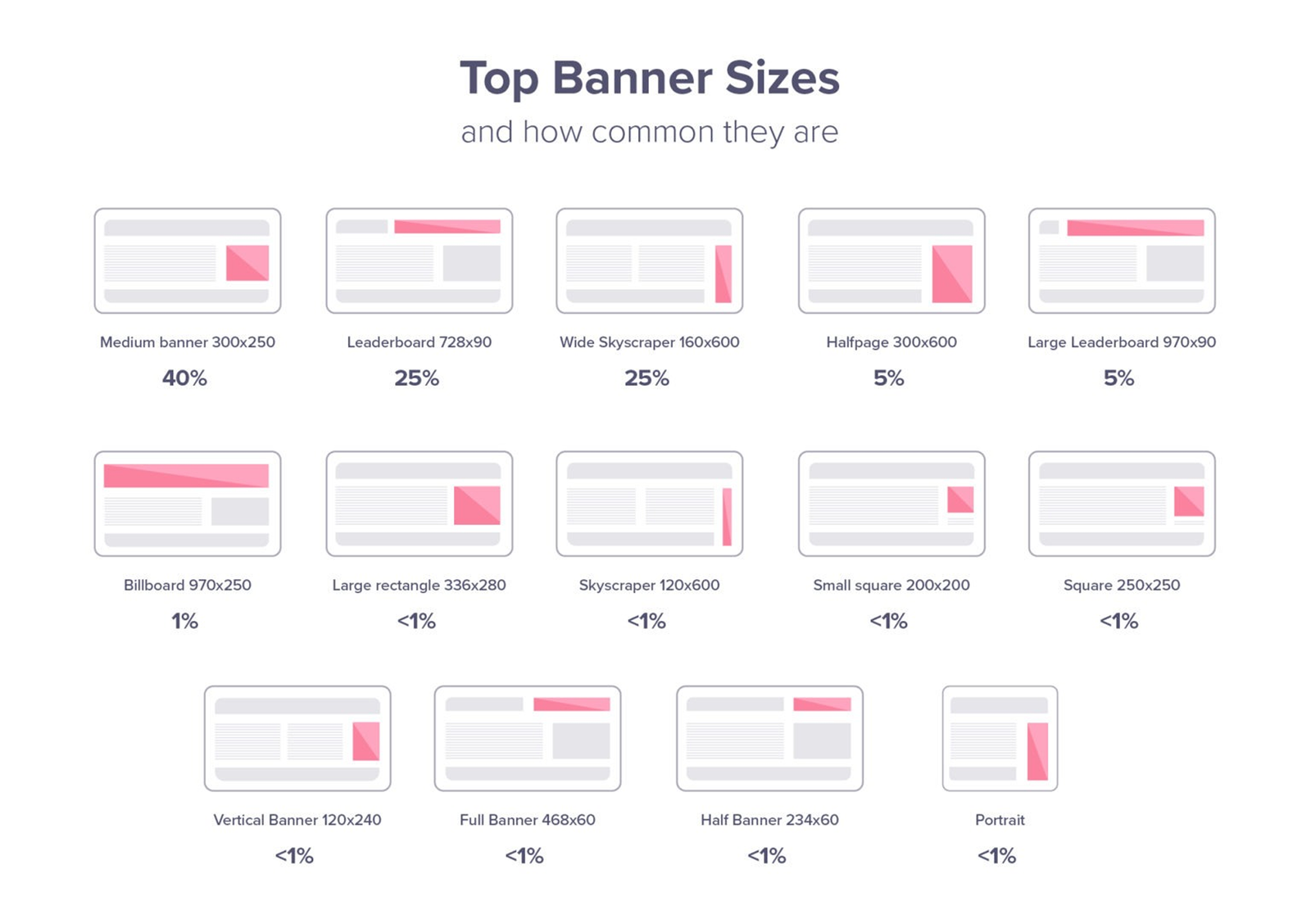
The specifications for banner ads vary depending on the shape of the banner and might be a medium to large rectangle, a tiny to medium square, a half page, and more. The three common ad sizes are skyscraper (160 X 600), medium rectangle (300 X 250), and billboard (728 X 90). A list of various banners and their sizes are mentioned below:
250 x 300 pixels for medium banner,
300 x 600 pixels for a half page,
970 or 728 by 90-pixel large leader-board,
970 x 250 pixels for leader-board,
336 x 280 pixels for Large Rectangle,
120 or 160 by 600 pixels for skyscraper,
200 x 200 pixels in a little square,
250 × 250 pixels for square,
120 x 240 pixels for a vertical banner,
468 x 60 pixels for a full banner,
234 x 60 pixels for a half-banner and
300 x 1050 pixels for a portrait.
The past few years have seen a sharp increase in advertising on smartphones. The various banner sizes that are suitable for mobile are as follows:
320x50 pixels for mobile leaderboard,
320×320 pixels for mobile full page flex,
320×100 pixels for large mobile banner,
250×250 pixels for square and
200×200 pixels for a small square
The Most Widely Used Ad Sizes:
According to a research survey carried out by The Match2One, the utilization of the various banner sizes is quite unevenly spread, with 4 variants predominating in the field of digital advertising which includes 160 by 600 pixels Wide Skyscraper; 12% , 300 by 250 pixels Medium Rectangle 40%, 728 by 90 billboard 25% and 320 by 50 Mobile Leader-board. These 4 sizes comprise 89% of total ad impressions.Source:
match2one.com.
However, the more different sizes you include, the broader your campaign's exposure, outreach, impact and consequently, the wider its success.
Key-Points to Remember While Designing a Banner Ad:
While you are designing your banner, there are certain instructions that you need to follow to make it engaging and catch the attention of the visitor.
1. Be Brief and Simple:
Keep your viewers from making assumptions. Banner ads must identify the target audience and the nature of the advertised good or service. The text must be interesting and legible and convey the message clearly.
2. Defining the Aims and Objectives of the Brand:
Brands need to consider carefully what constitutes a banner ad campaign's success as well as the intended action that viewers should carry out as a result of the banner ad.
3. Choosing the Appropriate Target Audience:
To whom is the advertisement aimed? The success of the banner ad as a whole depends on whether the company has the right target audience in view.
4. Company Logo:
The business objectives and artistic direction of the brand should both be taken into consideration. The corporate logos, premium graphics, clear language and overall company identity should all be taken into account when creating banner ads.
5. Call to Action (CTA):
Always include a Call to Action (CTA) in banner advertising and make sure it corresponds with the landing page. When someone clicks on your advertisement, they ought to know what to anticipate after that. Do they purchase event tickets? Visit a product page, please. Take them precisely where they're hoping to go if they were intrigued enough to click on the link in the advertisement.
6. Animation and Colors:
Make use of stunning images. Keep your banner ads professional by using eye-catching visuals. This comprises images, text, graphics and moving images. Consumers find high-quality advertisements more remembered and alluring.
Make your animation dynamic. Stay away from abrupt or flashy graphics techniques. This could detract from your brand image and be distracting. Keep your animation smooth and polished. Choose appropriate colours and use images only when it is required.
The nationality should also be taken into account, particularly if you have a certain destination in mind. Be sure to consider your design from the viewpoint of the user. For instance, the Middle East associates the colour red with danger while Asian nations link it with joy and happiness.
Here are some additional suggestions for creating a fantastic banner ad:
- Most people like red, but it conflicts with a traditional message.
- One of the most widely used colours for buttons with CTAs is orange.
- Blue frequently appears in logos.
- Pink is a feminine colour, however its femininity depends on its brightness and tone.
- White is ideal for evoking a feeling of economy. Mostly, white backgrounds are preferred in advertising.
7. Select the Proper Button Size:
In relation to other content, it shouldn't be excessively large or small.
8. Use Enticing Fonts and Text:
Now is the time to think about how you want your message, font and text to look To make your content look great, you need to do more than just choose pretty
fonts.You should also take into account readability, affinities with your brand's aesthetic, and consistency across several fonts. You should avoid using two typefaces fonts.
9. Use High-Quality Visuals:
Any visual elements, such as images or Graphics Interchange Format (GIF), should be of high quality to keep your advertisement looking professional. You could also use static images instead of moving images when it comes to keeping advertisements interesting.
10. Employ Metaphors:
You need original ideas if you want to succeed in the advertising game and avoid
losing leads. A strong metaphor makes an impact and effectively communicates your point.
All these elements are crucial for a brand since they help define success and guarantee that the banner's creative visual supports the company's goals. The audience must be intrigued to click on the banner in order for the cost-per-click model to be successful, so it must be enticing and intriguing.
When your designs are for publication, download the banner and select the file format that best fits your banner type and meets with the requirements of your publishing network.
To summarise, you should consider your brand image, product attributes and target market before creating a banner ad. For your design, this will act as a base. Keep your message brief and to the point to avoid confusing your audience. Try to give your design a creative boost if there is a lot of competition in the niche so it stands out from the sea of similar adverts. Additionally, keep your message concise and try to eliminate any unnecessary details. Do some research on the cultural sensitivities of your target audience.
Conclusion
In conclusion, a well-designed and customised web banner can make a big difference in attracting customers and promoting your business online. By focusing on clear messaging, eye-catching visuals, the right colours, and a strong call-to-action, you can create banners that capture attention and encourage more clicks. Keep your designs simple, relevant, and consistent with your brand to achieve better marketing results and support your business growth.


Leave A Reply