20 Apr 2026 • 12 Minutes Read
Written by Elore Digital Team
How AI is Changing Google Search Rankings
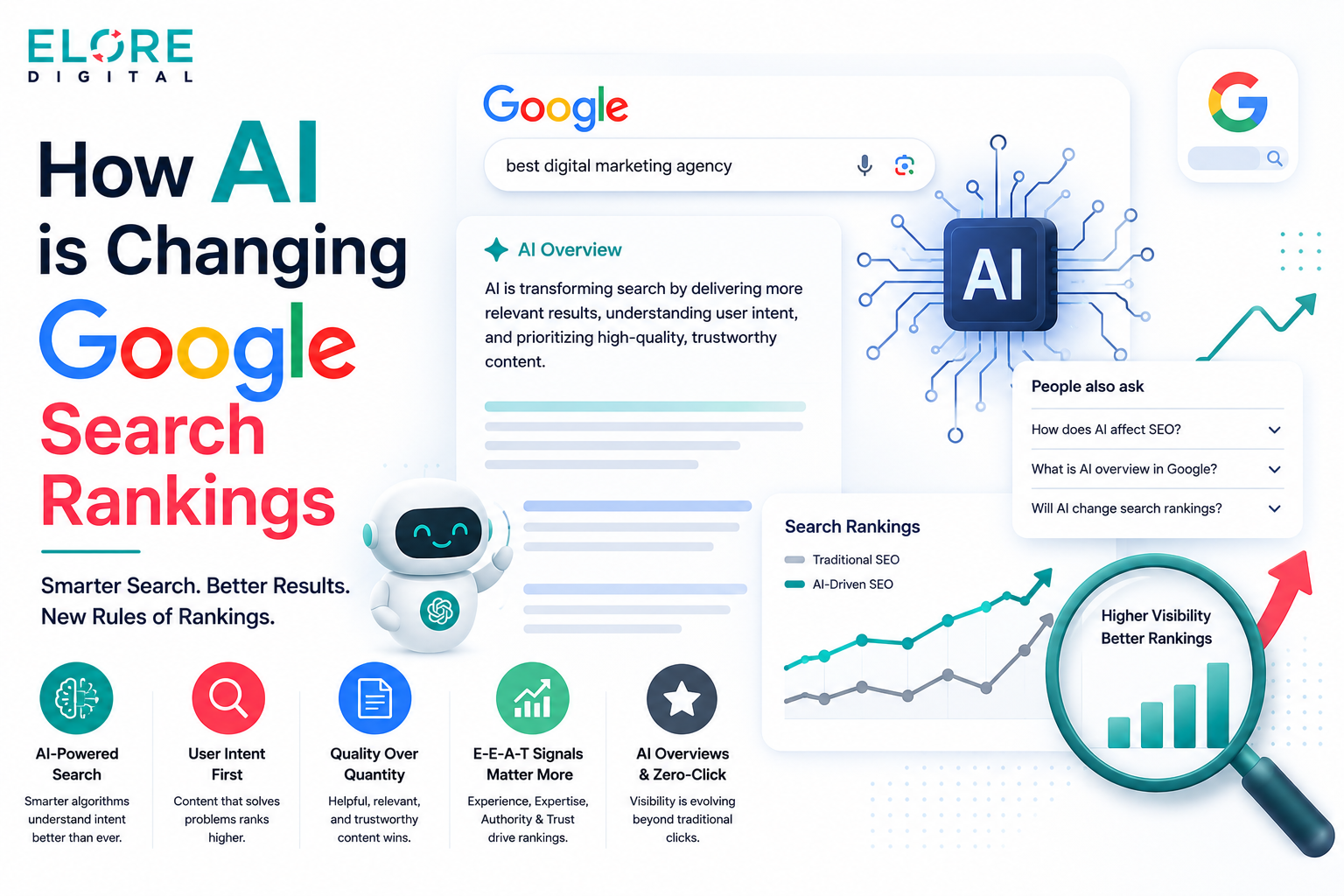
How AI is Changing Google Search Rankings — explore how smarter algorithms are reshaping SEO, improving search accuracy, and prioritizing user-focused content
Artificial intelligence is transforming the way search engines work and how content appears in search results. Google no longer relies only on basic algorithms and keywords. Instead it uses advanced AI systems to understand user behavior, intent, and content quality. This shift has changed the rules for bloggers, marketers, and website owners. To succeed today, content must be helpful, relevant, and written for real people. This blog explores how AI is reshaping Google search rankings and what it means for your content strategy.
1. The Evolution of Google Search with AI
AI has changed Google search from a simple keyword matching system into a smart and adaptive platform. In the past, ranking depended heavily on exact keywords and backlinks. Now AI helps Google understand meaning, context, and user intent. This shift allows search results to be more accurate and useful. Websites must now focus on quality and relevance rather than just optimization tricks. Understanding this evolution is important for anyone who wants to rank higher in search results.
1.1 From Traditional Algorithms to AI Systems
Google initially relied on simple algorithms that ranked pages based on keywords and backlinks. This approach often led to manipulation through keyword stuffing and low-quality link building. With the introduction of AI, search engines became more intelligent and capable of understanding content at a deeper level. AI systems analyse context, intent, and meaning rather than just matching words. This shift has reduced the effectiveness of outdated SEO tactics. Today, content must provide genuine value to users to rank successfully.
1.2 Introduction of Machine Learning in Search
Machine learning has allowed Google to continuously improve its search results by learning from user interactions. It analyses data such as click-through rates, time spent on pages, and user engagement. Based on this behaviour, search rankings are adjusted to prioritise useful content. Websites that satisfy user queries tend to perform better over time. Poor-quality or misleading content gradually loses visibility. This makes user-focused content more important than ever.
1.3 Role of AI in Understanding User Intent
AI helps Google interpret the true meaning behind search queries rather than just the words used. It considers factors like location, search history, and context to deliver accurate results. For example, the same keyword may show different results depending on user intent. This makes it essential for content creators to focus on solving real problems. Writing content that directly answers user questions improves ranking chances. Clear and relevant content is now a key success factor.
1.4 Key Google AI Updates Over Time
Google has introduced several AI-driven updates that have reshaped search rankings. These updates aim to improve the quality and relevance of search results. They reduce the impact of spammy tactics and low-value content. Each update encourages content creators to focus more on user experience. Staying informed about these changes helps maintain consistent rankings. Adapting to updates is essential for long-term SEO success.
2. AI and Search Intent Optimisation
Search intent has become one of the most important factors in ranking. AI helps Google identify whether a user wants information, a product, or a solution. Content that matches this intent performs better. Understanding your audience is now more important than ever. Writing content without considering intent can lead to low rankings.
2.1 Understanding User Behaviour Through AI
AI tracks how users interact with websites, including clicks, scrolling behaviour, and time spent on pages. This data helps Google identify which content is useful and engaging. Pages that keep users interested tend to rank higher in search results. If users quickly leave a page, it signals that the content may not be relevant. Understanding these behavioural patterns is important for improving performance. Creating engaging and informative content leads to better results.
2.2 Importance of Semantic Search
Semantic search allows Google to understand the meaning behind words rather than relying on exact keyword matches. AI recognises synonyms, related terms, and context within content. This helps deliver more accurate and relevant search results. Content should be written naturally and clearly for better performance. Overusing keywords can negatively impact readability and rankings. Focusing on meaning and clarity improves SEO outcomes.
2.3 How AI Interprets Search Queries
AI breaks down search queries to understand intent and context more effectively. It evaluates different meanings of words and how they relate to each other. This allows Google to deliver more precise answers to users. Content should address multiple aspects of a topic to increase visibility. Providing complete and well-structured information is essential. This approach helps improve both rankings and user satisfaction.
2.4 Impact on Content Relevance
Content relevance is one of the most important ranking factors in modern SEO. AI evaluates whether content matches the user's search intent and provides value. Pages that offer detailed and helpful information perform better. Thin or generic content struggles to rank in competitive search results. Ensuring that content is clear, accurate, and useful improves visibility. Relevance is key to long-term success.
3. Role of AI in Content Ranking
AI plays a central role in deciding which
content appears on top. It evaluates quality, originality, and usefulness. Content that provides value is prioritized. This has reduced the effectiveness of outdated tactics. Content creators must focus on building trust and authority.
3.1 AI-Based Content Quality Evaluation
AI systems analyse content quality by checking grammar, readability, and structure. They also evaluate whether the content fully answers the user's query. High-quality content that is easy to understand tends to rank higher. Poorly written or confusing content is often ignored by search engines. Clear formatting and logical flow improve user experience. Writing with simplicity and clarity is essential.
3.2 Importance of Natural Language Processing
Natural Language Processing (NLP) enables AI to understand human language more effectively. It helps Google interpret tone, meaning, and context within content. This means content should sound natural and conversational rather than robotic. Writing for humans rather than search engines improves engagement. Clear communication makes content more accessible. This ultimately leads to better rankings.
3.3 Content Personalisation and AI
AI personalises search results based on individual user behaviour and preferences. This means different users may see different results for the same query. Content should be tailored to specific audience needs for better performance. Understanding your target audience is crucial. Personalised and relevant content increases engagement. This helps improve overall search visibility.
3.4 Impact on Keyword Strategies
Traditional keyword strategies are no longer as effective as before. AI focuses more on context and meaning rather than keyword frequency. Keywords should be used naturally within content. Overuse of keywords can harm readability and rankings. Topic-based content performs better in modern SEO. A balanced and natural approach is recommended.
4. AI-Powered Google Algorithms
Modern Google algorithms rely heavily on AI. These systems improve search accuracy and user experience. They analyze large amounts of data quickly. Understanding these algorithms helps in creating better content. Staying informed gives you an advantage.
4.1 Overview of Major AI Algorithms
Google uses multiple AI-powered algorithms to deliver accurate search results. Each algorithm focuses on different aspects such as relevance, quality, and user experience. These systems work together to improve search accuracy. Understanding how they function helps in creating better content strategies. Consistency in quality is important for ranking success. Staying updated with algorithm changes is essential.
4.2 How RankBrain Works
RankBrain is a machine learning system that helps Google understand complex and unfamiliar search queries. It analyses patterns and predicts what users are looking for. This improves the accuracy of search results over time. Content that clearly answers questions performs better. Providing direct and useful information is important. RankBrain rewards relevance and clarity.
4.3 BERT and Its Impact on Search
BERT helps Google understand the context of words within a sentence. It focuses on how words relate to each other rather than treating them individually. This improves the accuracy of search results for complex queries. Content should be written naturally and clearly. Simple explanations improve user understanding. This leads to better performance in rankings.
4.4 Helpful Content System Explained
The Helpful Content System prioritises content that is genuinely useful for users. It targets low-quality content created only for ranking purposes. Websites that focus on providing value are rewarded. Content should be informative, original, and user-focused. Avoid writing just for search engines. User-first content performs best.
5. Impact of AI on SEO Strategies
AI has changed how
content optimization works. Traditional tactics are less effective now. Modern strategies focus on quality and user experience. Content must be engaging and informative. Adapting to these changes is essential.
5.1 Shift from Keywords to Intent-Based Content
Modern SEO has shifted from keyword-focused strategies to intent-based content creation. AI helps Google understand what users are truly looking for rather than just the words they type. This means content must directly answer user queries and provide meaningful solutions. Simply adding keywords is no longer enough to rank. Understanding audience needs is now essential for success. Content that aligns with user intent performs significantly better.
5.2 Importance of High-Quality Content
High-quality content is one of the strongest ranking factors in today’s AI-driven search environment. It builds trust, improves engagement, and increases retention. AI evaluates depth, clarity, and usefulness when ranking pages. Thin or duplicate content struggles to gain visibility. Well-researched and informative content performs better in competitive niches. Focusing on quality ensures long-term SEO success.
5.3 Role of User Experience and Engagement
User experience plays a critical role in determining search rankings. AI tracks how users interact with a website, including clicks, time spent, and navigation patterns. A smooth and fast-loading website keeps users engaged for longer. Poor design or slow pages can lead to higher bounce rates. Positive engagement signals improve rankings over time. Creating a user-friendly experience is essential.
5.4 Adapting to AI-Driven Ranking Factors
SEO strategies must continuously evolve to keep up with AI-driven changes. What worked in the past may not be effective today. Staying updated with algorithm updates is important for maintaining rankings. Regularly improving content helps stay competitive. Flexibility allows marketers to adjust their approach when needed. Adapting quickly provides a strong advantage.
6. AI and Voice Search Optimisation
Voice search is growing rapidly. AI powers voice assistants and improves accuracy. This changes how people search. Content must adapt to conversational queries. Optimizing for voice search can increase traffic.
6.1 Growth of Voice Search Technology
Voice search has grown rapidly due to the increasing use of smart devices and virtual assistants. It offers a faster and more convenient way for users to search for information. AI continues to improve voice recognition accuracy. This trend is expected to grow in the coming years. Businesses must adapt to this shift to remain competitive. Early optimisation can provide a strong advantage.
6.2 AI Assistants and Search Behaviour
AI assistants have changed how users interact with search engines. Instead of typing short keywords, users now ask complete questions. This has made search queries more natural and conversational. Content should be structured to answer these questions clearly. A direct and simple approach works best. Understanding this behaviour improves content performance.
6.3 Optimising Content for Voice Queries
Content for voice search should be clear, concise, and easy to understand. Users expect quick and accurate answers to their questions. Using natural language and conversational phrases improves effectiveness. Short sentences and structured answers work best. This makes it easier for AI to select your content. Optimisation for voice search increases visibility.
6.4 Conversational Search Trends
Search behaviour is becoming more conversational as AI technology advances. Users prefer asking questions in a natural tone rather than using keywords. Content should reflect this change in style. Writing in a friendly and engaging tone improves readability. It also increases user interaction. Conversational content performs better in modern search results.
7. AI in Visual and Image Search
Visual search is becoming more important. AI can recognize images and understand context. This opens new opportunities for content creators. Optimizing images can improve rankings. Visual content attracts more users.
7.1 Introduction to Visual Search Technology
Visual search allows users to search using images instead of text. AI analyses images and finds similar results across the web. This makes searching more interactive and efficient. It is especially useful for shopping and product discovery. Websites that include relevant images benefit from this trend. Visual content enhances overall engagement.
7.2 How AI Recognises Images
AI uses advanced algorithms to identify objects, patterns, and details within images. It can understand what an image represents and how it relates to user queries. This improves the accuracy of visual search results. Properly optimised images perform better in rankings. Clear and relevant visuals are important. Image recognition is becoming more advanced over time.
7.3 Importance of Image Optimisation
Image optimisation improves website speed and user experience. Compressed images load faster and reduce bounce rates. AI considers both image quality and relevance when ranking pages. Using proper file names and captions improves visibility. Optimised images also support overall SEO performance. This helps drive additional traffic.
7.4 Role of Alt Text in Rankings
Alt text provides a description of images for search engines and users. It helps AI understand the content of an image. This also improves accessibility for visually impaired users. Writing clear and relevant alt text is important. It supports overall content optimisation. Proper use of alt text can improve search rankings.
8. AI and User Experience Signals
User experience plays a major role in rankings. AI tracks how users interact with websites. Positive experiences improve rankings. Poor experiences reduce visibility. Creating a smooth experience is essential.
8.1 Importance of Page Experience
Page experience is a key factor in modern search rankings. Fast-loading and responsive pages create a positive impression on users. AI evaluates these factors to determine ranking positions. Poor performance can lead to lower visibility. Improving speed and usability enhances user satisfaction. A better experience leads to higher rankings.
8.2 Core Web Vitals and AI
Core Web Vitals measure important aspects such as loading speed, interactivity, and visual stability. AI uses these metrics to assess website performance. Websites that meet these standards rank better. Slow or unstable pages negatively impact user experience. Improving these metrics is essential for SEO. Performance optimisation plays a major role.
8.3 Bounce Rate and Engagement Metrics
Bounce rate indicates how quickly users leave a website. High bounce rates suggest that content may not be relevant or engaging. AI tracks these signals to evaluate content quality. Engaging and informative content keeps users on the page longer. This improves overall performance. Reducing bounce rates is important for rankings.
8.4 AI Role in Behavioural Analysis
AI analyses user behaviour to understand what content performs best. It tracks clicks, scrolling, and interaction patterns. This data helps improve search results over time. Content that meets user expectations ranks higher. Consistency in quality is important. Understanding behaviour leads to better strategies.
9. Challenges of AI in Search Rankings
AI brings many benefits but it also introduces new challenges for content creators. As more websites use AI tools, competition in search rankings has become much stronger. Standing out now requires better quality, originality, and a clear understanding of user needs. Content creators must adapt quickly to constant algorithm changes and shifting trends. Ignoring these changes can lead to a drop in visibility and traffic. Understanding these challenges helps in building smarter strategies that focus on long term growth and consistent performance.
9.1 Algorithm Updates and Uncertainty
Frequent algorithm updates can create uncertainty for website owners. AI-driven changes make rankings more dynamic and unpredictable. This can affect traffic and visibility. Staying informed about updates helps reduce risks. Regular content updates improve stability. Adapting quickly is essential for maintaining rankings.
9.2 Content Authenticity Issues
The rise of AI-generated content has increased competition and duplication. Many websites publish similar content, making it harder to stand out. Authentic and original content performs better in search results. Sharing unique insights adds value. Building trust with users is important. Originality remains a key ranking factor.
9.3 Over-Reliance on AI Tools
Relying too much on AI tools can reduce content quality and creativity. Automated content may lack depth and originality. It is important to use AI as a support tool rather than a replacement. Human input adds emotion and uniqueness. A balanced approach works best. Combining both improves results.
9.4 Maintaining Human Creativity
Human creativity remains essential in content creation. AI cannot fully replace original ideas and perspectives. Creative content engages users and builds stronger connections. Unique writing helps differentiate your content from competitors. This improves authority and trust. Creativity is key to long-term success.
10. Future of AI in Google Search Rankings
The future of search will be more AI driven as technology continues to advance. Search engines will better understand user behavior, preferences, and intent. Results will become more personalized and accurate for each user. Keeping up with new trends will be important for staying competitive. Those who prepare early will have a clear advantage. AI will continue to shape how content is created and ranked online.
10.1 Emerging AI Technologies in Search
New AI technologies are continuously improving search engine performance. These advancements make search results more accurate and efficient. Content must evolve to match these changes. Staying updated helps maintain visibility. Innovation plays a key role in SEO success. Early adoption provides a competitive advantage.
10.2 Personalisation and Predictive Search
AI is making search results more personalised for each user. It analyses behaviour to predict what users need. This improves relevance and user satisfaction. Content should target specific audience segments. Personalisation increases engagement. Understanding your audience is more important than ever.
10.3 AI and Zero-Click Searches
Zero-click searches provide answers directly on the search results page. Users may not need to visit a website. This increases competition for visibility. Content should be clear and direct to appear in featured snippets. Providing quick answers improves chances of selection. Optimisation for snippets is important.
10.4 Predictions for Future Algorithms
Future algorithms will focus even more on user experience and content quality. AI will become more advanced in understanding human language. Search engines will prioritise helpful and relevant content. Websites must adapt to these changes to stay competitive. Continuous improvement is necessary. The focus will remain on value-driven content.
Conclusion
Artificial intelligence has completely transformed how Google ranks content. It has shifted the focus from simple keyword usage to meaningful and helpful content that truly serves users. Today success in search results depends on understanding intent, creating valuable content, and providing a great user experience. AI rewards authenticity, clarity, and depth while reducing the impact of outdated tactics. For content creators this is an opportunity to build trust and connect with audiences in a more meaningful way. By focusing on real value and staying updated with changes, you can grow your visibility and attract consistent traffic. The future of search belongs to those who create content for people first and algorithms second.





Leave A Reply