08 May 2026 • 11 Minutes Read
Written by Elore Digital Team
A Complete Framework for Designing High Converting Landing Pages
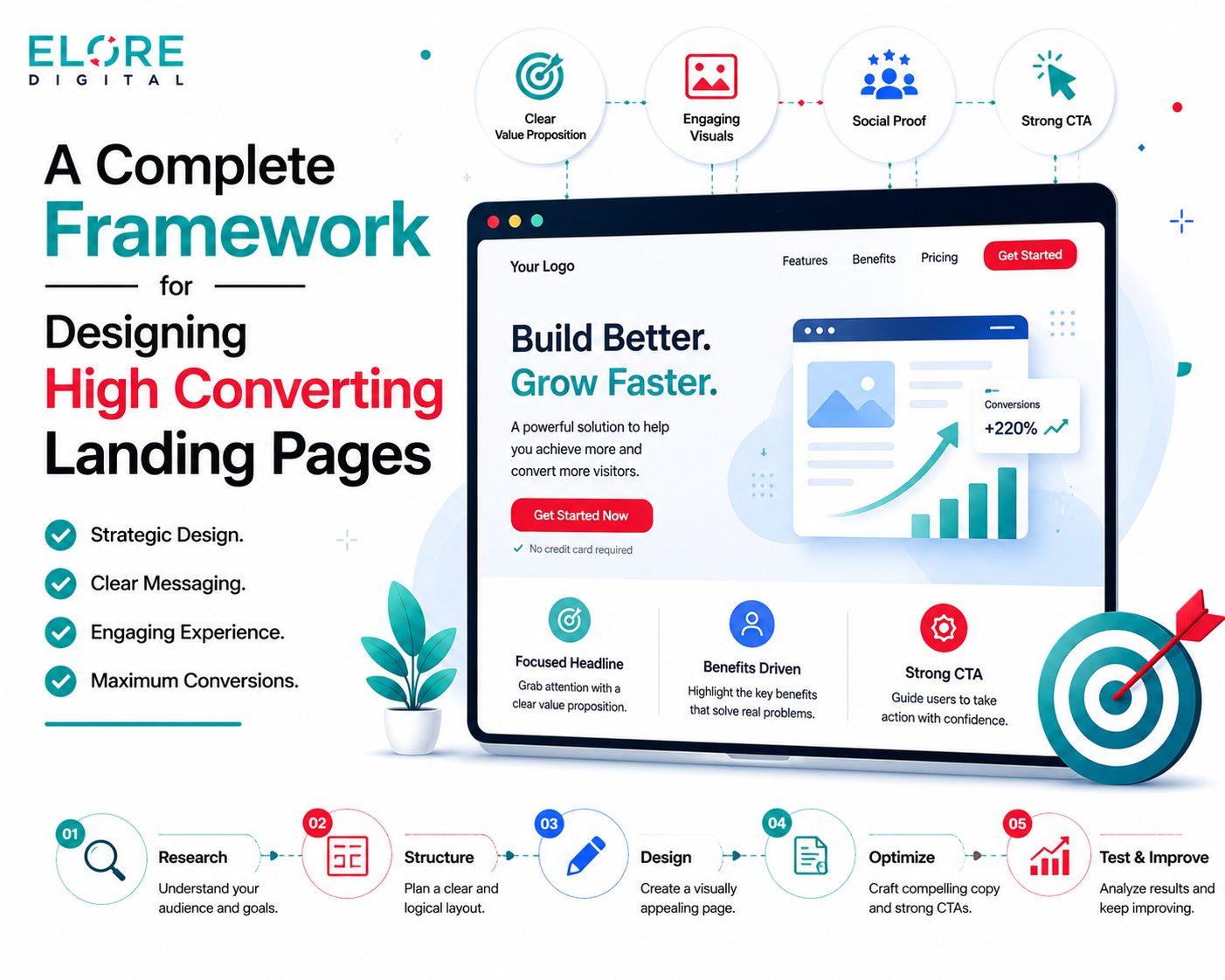
A Complete Framework for Designing High Converting Landing Pages – step-by-step strategy to create landing pages that attract, engage, and convert visitors into customers
Creating a landing page is easy, but designing one that actually converts visitors into customers requires a clear strategy and the right approach. Many businesses struggle because their pages look good but fail to deliver results. A high converting landing page is not just about design, it is about understanding your audience, delivering the right message, and guiding users toward a specific action. Every element, from the headline to the call to action, plays an important role in influencing user decisions. In this guide, you will learn a complete framework that helps you create landing pages that are not only visually appealing but also focused on performance and conversions.
1. Understanding the Purpose of a Landing Page
A landing page is designed with a single goal in mind. It focuses on guiding visitors toward a specific action without distractions. Unlike a homepage, it removes unnecessary links and keeps users engaged with one clear message. This clarity improves user experience and increases conversions. A well structured landing page connects user needs with a clear solution. Understanding its purpose is the first step toward better results.
1.1 What Defines a Landing Page
A landing page is a standalone page created for a specific marketing campaign or offer. It is built to focus on one clear objective, such as collecting leads or driving sales. Unlike regular pages, it avoids multiple navigation options that can distract users. Every element on the page is aligned with a single goal. This focused approach helps improve user attention and increases the chances of conversion. A clear definition ensures better planning and execution.
1.2 Types of Landing Pages
There are several types of landing pages depending on your goal and audience. Lead generation pages are used to collect user information such as emails or contact details. Click through pages guide users toward another page where they complete an action like a purchase. Sales pages are more detailed and aim to convert visitors directly into customers. Each type serves a specific purpose and requires a different content strategy. Choosing the right type is essential for achieving your desired outcome.
1.3 Key Goals and Objectives
Every landing page should have a clearly defined goal that guides its design and content. This could include increasing sign ups, generating leads, or boosting product sales. Without a clear objective, the page can become confusing and ineffective. Setting measurable goals also helps track performance and success. When your objective is focused, it becomes easier to create content that drives action. A strong goal keeps everything aligned.
1.4 How Landing Pages Fit into Marketing Funnels
Landing pages play an important role in guiding users through the marketing funnel. At the awareness stage, they introduce users to your offer or brand. At the consideration stage, they provide more detailed information and build trust. At the decision stage, they encourage users to take action. Each landing page should match the user’s position in the funnel. This alignment improves engagement and increases conversions.
2. Knowing Your Target Audience
Understanding your audience is one of the most important factors in creating a successful landing page. If you do not know who you are speaking to, your message will not connect effectively. A strong understanding of your audience helps you create content that feels relevant and engaging. It allows you to address their needs and concerns directly. This leads to better trust and higher
conversion rates. The more specific your targeting, the better your results.
2.1 Identifying Your Ideal Customer
Identifying your ideal customer helps you focus your efforts on the right audience. This includes analysing demographics such as age, location, and interests. It also involves understanding behaviour patterns and preferences. When you know your ideal customer, you can tailor your messaging to match their expectations. This makes your landing page more relevant and effective. A clear customer profile improves overall marketing performance.
2.2 Understanding User Intent
User intent refers to the reason behind a visitor’s action when they land on your page. Some users may be looking for information, while others may be ready to make a purchase. Understanding this intent helps you create content that meets their expectations. If your content matches their needs, they are more likely to stay and engage. Misaligned content can lead to higher bounce rates. Matching intent is key to conversion success.
2.3 Creating Buyer Personas
Buyer personas are detailed profiles that represent your ideal customers. They include information such as goals, challenges, and motivations. These personas help you visualise your audience and create more personalised content. When you design your landing page with a specific persona in mind, your messaging becomes more effective. It allows you to speak directly to your audience. This improves user connection and engagement.
2.4 Mapping Customer Pain Points
Pain points are the problems or challenges your audience is facing. Identifying these issues helps you position your product or service as a solution. Your landing page should clearly address these pain points and offer value. When users feel understood, they are more likely to trust your message. Highlighting solutions builds credibility and interest. This approach increases the chances of conversion.
3. Crafting a Compelling Value Proposition
A value proposition is a clear statement that explains why a user should choose your offer. It highlights the benefits and sets you apart from competitors. A strong value proposition is simple, direct, and focused on user needs. It should be visible as soon as the user lands on the page. When done correctly, it captures attention and encourages users to stay. This makes it a key element of high converting landing pages.
3.1 What Makes a Strong Value Proposition
A strong value proposition clearly explains the benefit of your offer in simple terms. It avoids confusion and focuses on what the user will gain. It should answer the question of why the user should choose you. Clarity and relevance are essential for effectiveness. A well crafted message builds interest quickly. This helps improve engagement and conversions.
3.2 Communicating Benefits Clearly
Focusing on benefits rather than features makes your message more appealing. Users are more interested in how your offer helps them rather than technical details. Clear communication ensures that your message is easy to understand. Avoid complex language or jargon that can confuse users. Simple and direct content performs better. This improves user experience and trust.
3.3 Differentiating from Competitors
Standing out from competitors is important in a crowded market. Highlight what makes your offer unique and valuable. This could be better quality, pricing, or customer support. Clear differentiation helps users make decisions quickly. It gives them a reason to choose your brand. Strong positioning increases conversion rates.
3.4 Aligning Value with Audience Needs
Your value proposition should match what your audience is looking for. Understanding their needs helps you create a message that feels relevant. When your offer aligns with user expectations, engagement increases. This makes your landing page more effective. Relevance builds trust and encourages action.
4. Writing High Converting Headlines
Headlines are the first thing users notice when they land on your page. They play a major role in capturing attention and encouraging users to stay. A strong headline clearly communicates value within seconds. If the headline fails, users may leave without exploring further. It should be simple, relevant, and focused on user benefits. Writing effective headlines requires clarity, creativity, and testing.
4.1 Characteristics of Effective Headlines
Effective headlines are clear, direct, and focused on the user’s needs. They communicate the main benefit without confusion. A good headline avoids unnecessary complexity and gets straight to the point. It should quickly tell users what they can expect. Strong headlines also create curiosity that encourages further reading. Clarity and relevance make headlines more impactful.
4.2 Using Emotional and Power Words
Emotional and power words help create a strong connection with users. They can trigger curiosity, urgency, or excitement depending on the message. Words like easy, proven, or instant can influence decision making. However, they should be used naturally and not forced. Overuse can make content feel unrealistic. Balanced use improves engagement and trust.
4.3 Keeping Headlines Clear and Concise
Short and simple headlines perform better because they are easy to understand. Users usually scan content quickly, so clarity is important. Avoid adding too many words that dilute the message. Focus on one key idea that delivers value. A concise headline improves readability and user experience. Simplicity often leads to better results.
4.4 Testing and Optimising Headlines
Testing different headline variations helps identify what works best. Small changes in wording can have a big impact on performance. Use data to measure which headline gets more engagement. Continuous testing allows you to improve over time. Optimisation should be based on real user behaviour. This leads to better conversion rates.
5. Designing a User Friendly Layout
A well designed layout helps users navigate your landing page easily. It ensures that important information is presented clearly and logically. A cluttered design can confuse users and reduce engagement. Clean and structured layouts improve readability and focus. Visual hierarchy guides users toward key elements like CTAs. Good design enhances both usability and conversions.
5.1 Importance of Visual Hierarchy
Visual hierarchy helps organise content in a way that guides user attention. Important elements like headlines and CTAs should stand out clearly. Size, colour, and placement all play a role in hierarchy. This makes it easier for users to scan the page. A strong hierarchy improves user experience. It also increases the chances of conversion.
5.2 Structuring Content for Readability
Content should be easy to read and well organised. Use short paragraphs and clear sections to break information. Proper spacing improves readability and keeps users engaged. Avoid long blocks of text that can overwhelm visitors. Structured content makes it easier to understand your message. This improves overall user experience.
5.3 Using White Space Effectively
White space helps create a clean and balanced design. It reduces clutter and improves focus on important elements. Proper spacing allows users to process information more easily. It also enhances visual appeal. A well spaced layout feels more professional and user friendly. Simplicity improves effectiveness.
5.4 Mobile Responsive Design Principles
Many users access landing pages on mobile devices. Your page should adapt to different screen sizes for a smooth experience. Responsive design ensures that content remains readable and accessible. Buttons and CTAs should be easy to click on smaller screens. Mobile optimisation improves engagement and conversions. It is essential for modern websites.
6. Creating Persuasive Call to Actions
Call to actions guide users toward taking the next step on your landing page. They are one of the most important elements for driving conversions. A strong CTA tells users exactly what to do and why they should do it. It should be clear, visible, and easy to understand. The design and wording both play a key role. Effective CTAs can significantly improve results.
6.1 What Makes a CTA Effective
An effective CTA is clear and action focused. It uses simple language that tells users what will happen next. It should stand out visually from the rest of the page. The message should create a sense of value. Strong CTAs reduce confusion and guide users easily. This increases conversion rates.
6.2 Placement and Visibility Strategies
CTAs should be placed where users can easily find them. They should appear above the fold and at key points on the page. Repeating CTAs can improve engagement. However, they should not feel overwhelming. Proper placement ensures users always know the next step. Visibility is key to effectiveness.
6.3 CTA Copywriting Techniques
CTA text should be clear, direct, and benefit driven. Instead of generic phrases, use language that highlights value. For example, Get Started Today is more engaging than Submit. Personalised CTAs can perform better. Good copy encourages users to take action. Simple wording creates better results.
6.4 A B Testing for CTAs
Testing different CTA variations helps improve performance. You can test changes in text, design, or placement. Data helps identify what works best for your audience. Continuous testing leads to better optimisation. Small improvements can have a big impact. Testing ensures consistent growth.
7. Building Trust and Credibility
Trust is essential for converting visitors into customers. Users are more likely to take action when they feel confident in your offer. Adding credibility elements helps reduce doubt and build confidence. These elements show that your brand is reliable and trustworthy. Trust building should be a key part of your landing page strategy. It directly impacts conversions.
7.1 Using Testimonials and Reviews
Testimonials provide real feedback from previous customers. They help new users feel more confident about your offer. Positive reviews build trust and credibility. They show that others have had a good experience. Authentic testimonials are more effective. Social proof plays a powerful role in decision making.
7.2 Adding Trust Badges and Certifications
Trust badges show that your website is secure and reliable. Certifications add authority and credibility. These elements reduce user concerns about safety. Displaying them clearly improves confidence. Users feel more comfortable sharing information. This increases conversions.
7.3 Showcasing Case Studies
Case studies provide detailed examples of success. They show how your product or service has helped others. Real results make your offer more believable. Case studies build strong credibility. They provide proof of effectiveness. This encourages users to trust your brand.
7.4 Addressing Objections Proactively
Users may have doubts before taking action. Addressing these concerns helps remove barriers. Provide clear and honest answers to common questions. This builds transparency and trust. When users feel informed, they are more confident. Reducing objections improves conversions.
8. Optimising for Speed and Performance
Page speed has a direct impact on user experience and conversions. Slow loading pages can frustrate users and cause them to leave. Fast pages keep users engaged and improve retention. Performance optimisation ensures smooth functionality. It involves improving speed and reducing delays. A well optimised page performs better overall.
8.1 Importance of Page Load Speed
Fast loading pages improve user satisfaction. Slow pages increase bounce rates and reduce engagement. Users expect quick access to information. Speed directly affects conversions. Even small delays can impact results. Performance should always be a priority.
8.2 Image and Media Optimisation
Large images can slow down your page significantly. Optimising images helps improve loading speed. Use appropriate formats and compress files. Balance quality with performance for best results. Efficient media improves user experience. Faster pages perform better.
8.3 Minimising Code and Scripts
Excess code can reduce page performance. Removing unnecessary scripts improves speed. Clean and efficient coding enhances functionality. Simplifying your page reduces loading time. Better performance leads to better user experience. Optimisation improves results.
8.4 Tools for Performance Testing
Performance testing tools help identify issues on your page. They provide insights into speed and usability. Regular testing ensures your page stays optimised. Use data to make improvements. Monitoring performance helps maintain quality. Continuous optimisation is important.
9. Leveraging SEO for Landing Pages
SEO helps your landing page reach a wider audience through search engines. It ensures that your page appears for relevant searches. Good SEO practices improve visibility and traffic. Optimisation involves keywords, content, and structure. A well optimised page attracts qualified users. This increases the chances of conversion.
9.1 Keyword Research for Landing Pages
Keyword research helps you understand what users are searching for. It allows you to target relevant search terms. Using the right keywords improves visibility. Focus on user intent when selecting keywords. Proper research leads to better results. It forms the foundation of SEO.
9.2 On Page SEO Best Practices
On page SEO involves optimising content and structure. Use proper headings and formatting for clarity. Ensure your content is relevant and valuable. Internal linking can improve navigation. Good practices support
better rankings. SEO improves long term performance.
9.3 Optimising Meta Tags and Content
Meta tags help search engines understand your page. Clear titles and descriptions improve click rates. Optimised content increases visibility. Accurate information attracts the right audience. Consistency is important for SEO success. Well written tags enhance performance.
9.4 Tracking and Measuring SEO Performance
Tracking performance helps you understand what is working. Use analytics tools to monitor traffic and engagement. Data provides insights for improvement. Adjust strategies based on results. Continuous monitoring improves outcomes. SEO requires ongoing effort.
10. Testing Analysing and Improving Performance
Creating a landing page is only the beginning. Continuous improvement is necessary for long term success. Analysing user behaviour helps identify areas for improvement. Data driven decisions lead to better results. Regular testing keeps your page effective. Optimisation should always be ongoing.
10.1 Importance of A B Testing
A B testing helps compare different versions of your page. It shows which version performs better. Testing reduces guesswork and improves accuracy. Data driven decisions lead to better results. Continuous testing ensures improvement. It is essential for optimisation.
10.2 Key Metrics to Track
Tracking the right metrics is important for success. Focus on conversion rate, bounce rate, and engagement. These metrics provide valuable insights. Understanding data helps improve strategies. Measurement guides decision making. It ensures better performance.
10.3 Using Analytics Tools Effectively
Analytics tools help track user behaviour on your page. They provide detailed insights into performance. Use this data to identify issues and opportunities. Effective use of tools improves optimisation. Data driven strategies lead to success. Insights help refine your approach.
10.4 Continuous Optimisation Strategies
Optimisation is an ongoing process that requires regular updates. Keep testing new ideas and improvements. Adapt to changing user behaviour and trends. Continuous effort ensures better performance. Growth comes from consistent improvement. Long term success depends on optimisation.
Conclusion
Designing a high converting landing page is not about adding more elements, it is about using the right elements in a focused and strategic way. From understanding your audience to crafting a clear value proposition and optimising performance, every step plays a crucial role in driving results. A successful landing page combines strong messaging, clean design, and continuous testing to guide users toward a specific action. It is important to remember that there is no one time solution, improvement comes through analysing data and making regular updates. By following this complete framework, you can create landing pages that not only attract visitors but also turn them into valuable customers.


Leave A Reply