15 Jul 2026 • 4 Minutes Read
Written by Elore Digital Team
5 Signs Your Business Website Is Costing You Leads (And How to Fix Them)
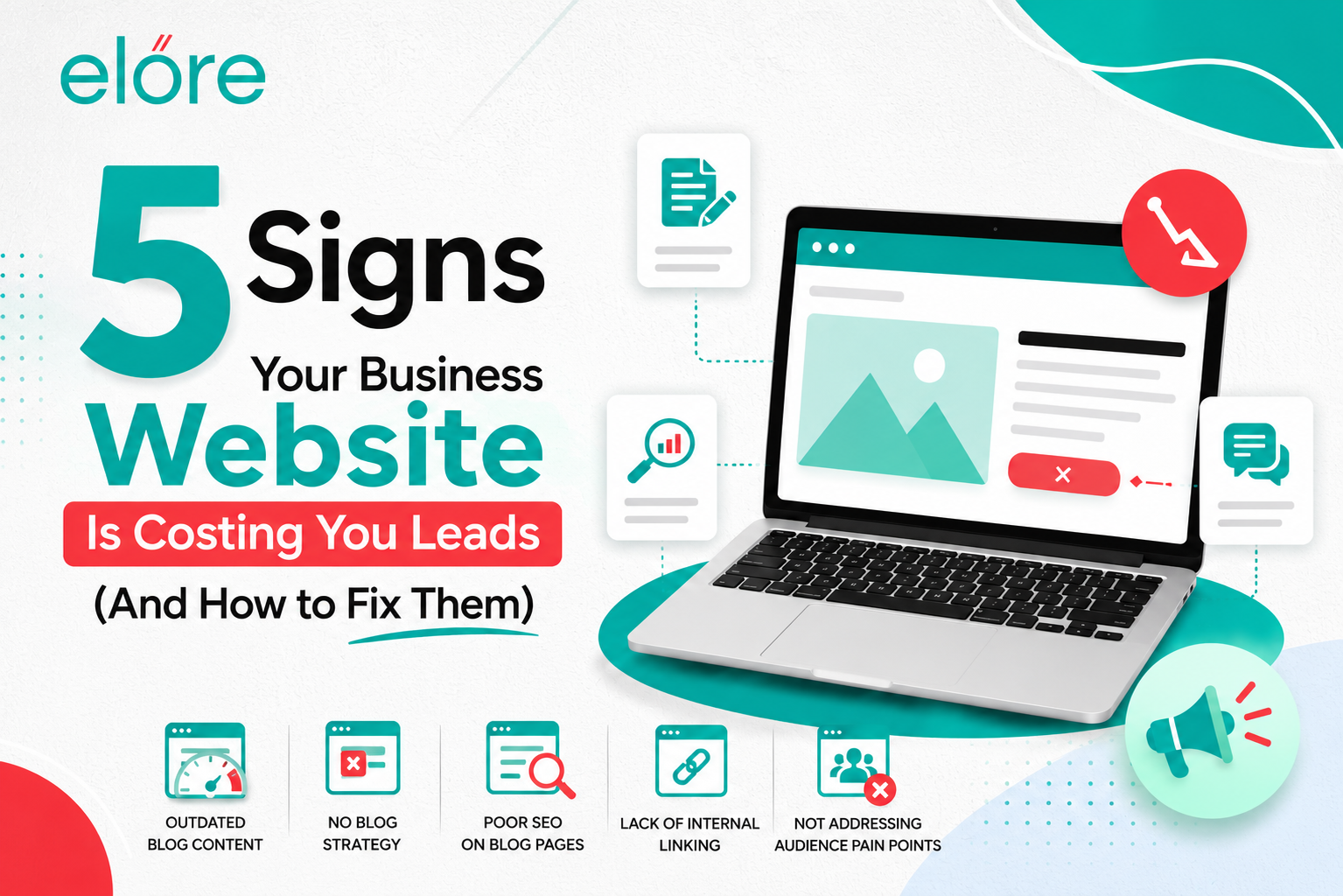
5 website mistakes hurting your SEO, content strategy, and lead generation growth
Your website is often the first interaction a potential customer has with your business before a phone call, before an email, and before they ever walk through your door, making it your digital storefront, your sales representative, and your first impression all in one. The problem is that most business owners assume that if their website is live, it is working, but there is a big difference between a website that simply exists and one that actually converts. A site can look polished and still quietly push potential customers away long before they fill out a contact form or click call now. Below are five of the most common and often overlooked signs that your website is not just underperforming but actively costing you leads, along with practical fixes you can start implementing today.
1. Your Website Takes Too Long to Load
Page speed isn't just a technical metric — it's a trust signal and a conversion factor. When a page takes several seconds to load, most visitors don't wait around. They assume the site is broken, outdated, or unreliable, and they leave before they even see what you offer.
This matters even more on mobile, where slow load times are one of the fastest ways to lose a potential lead who found you through a Google search or social media ad.
Common causes:
Uncompressed images and large media files
Too many third-party scripts and plugins
Poor web hosting or server response times
Unoptimized code (bloated CSS/JavaScript)
The fix: Run your site through a page speed testing tool, compress images before uploading, and remove any plugins or scripts you don't actually use. A fast, lightweight website builds trust before a visitor reads a single word of your content.
2. It's Not Truly Mobile-Friendly
Having a website that "shrinks to fit" a phone screen isn't the same as being mobile-friendly. Real mobile optimization means buttons are easy to tap, text is readable without zooming, forms are simple to fill out, and navigation menus don't require guesswork.
Since the majority of local business searches happen on mobile devices, a clunky mobile experience isn't a minor inconvenience — it's a direct leak in your lead pipeline. If someone finds your business while searching on their phone and struggles to navigate your site, they'll simply move to the next result.
The fix: Test your website yourself, on your own phone, as if you were a first-time visitor. Can you find your services, contact info, and a way to reach out in under 10 seconds? If not, your mobile experience needs work.
3. There's No Clear Call-to-Action (CTA)
A beautifully designed website with no clear next step is like a shop with no cashier — visitors browse, but nothing happens. Every page on your site should answer one simple question for the visitor: "What do you want me to do next?"
Whether it's "Book a Consultation," "Get a Free Quote," or "Call Us Today," your call-to-action needs to be visible, specific, and repeated across key pages — not buried in a footer or hidden behind vague language like "Learn More."
The fix: Add a clear, action-oriented CTA above the fold on your homepage and service pages. Use direct language, contrasting colors, and make it easy to act — whether that's a phone number, a form, or a booking link.
4. Your Website Doesn't Build Trust Fast Enough
People don't buy from businesses they don't trust — and trust is built (or lost) within seconds of landing on a page. If your website is missing genuine trust signals, visitors may leave to verify your credibility elsewhere, and many won't come back.
Trust signals your site may be missing:
Real client testimonials or case studies
Clear business information (address, phone number, service areas)
Professional, up-to-date photography — not generic stock images
Certifications, awards, or years of experience
Reviews linked from Google or third-party platforms
This ties directly into what search engines look for too. Google increasingly rewards websites that demonstrate real Experience, Expertise, Authoritativeness, and Trustworthiness (E-E-A-T) — meaning trust-building content doesn't just help conversions, it helps your search rankings as well.
The fix: Add authentic testimonials, showcase real work or results, and make your contact information easy to find. If you serve a local area, your business name, address, and phone number should be consistent everywhere they appear online.
5. Your Content Doesn't Answer the Questions Your Customers Are Actually Asking
Many business websites talk about the business — services, mission, history — without addressing what the customer actually searched for. If a visitor lands on your page looking for an answer and doesn't find it quickly, they'll bounce back to Google and click a competitor instead.
This is increasingly important as search evolves. AI-powered search tools and answer engines now prioritize content that directly and clearly answers real questions, in plain language, with useful structure — not vague marketing copy.
The fix: Structure your content around the actual questions your customers ask before hiring someone in your industry. Use clear headings, direct answers near the top of the page, and everyday language rather than jargon. This helps both human visitors and search engines quickly understand — and trust — what you offer.
Frequently Asked Questions
How do I know if my website is losing leads? Look at your website analytics — high bounce rates, low time-on-page, and few form submissions or calls are strong indicators. Pair this with a simple test: try navigating your own site as a first-time visitor would.
Is a slow website really that big of a deal? Yes. Slower loading pages consistently see higher visitor drop-off, especially on mobile, where patience for delays is even lower.
What's the fastest fix on this list? Adding a clear, visible call-to-action is usually the quickest win — it requires no redesign, just clearer messaging and placement.
Final Thoughts: Turn Your Website Into a Lead-Generating Asset
A website isn't a "set it and forget it" project — it's a living part of your business that should be evaluated, tested, and improved regularly. The good news is that most of these issues are fixable without a full redesign. Small, targeted changes to speed, mobile experience, trust signals, and content clarity can make a measurable difference in how many visitors turn into real leads.You have the business. We have the strategy. If your website could use a professional audit to uncover exactly where it's losing leads — and how to fix it — that's exactly the kind of work we do.


Leave A Reply