24 Apr 2026 • 19 Minutes Read
Written by Elore Digital Team
5 Best AI Tools for SEO in 2026
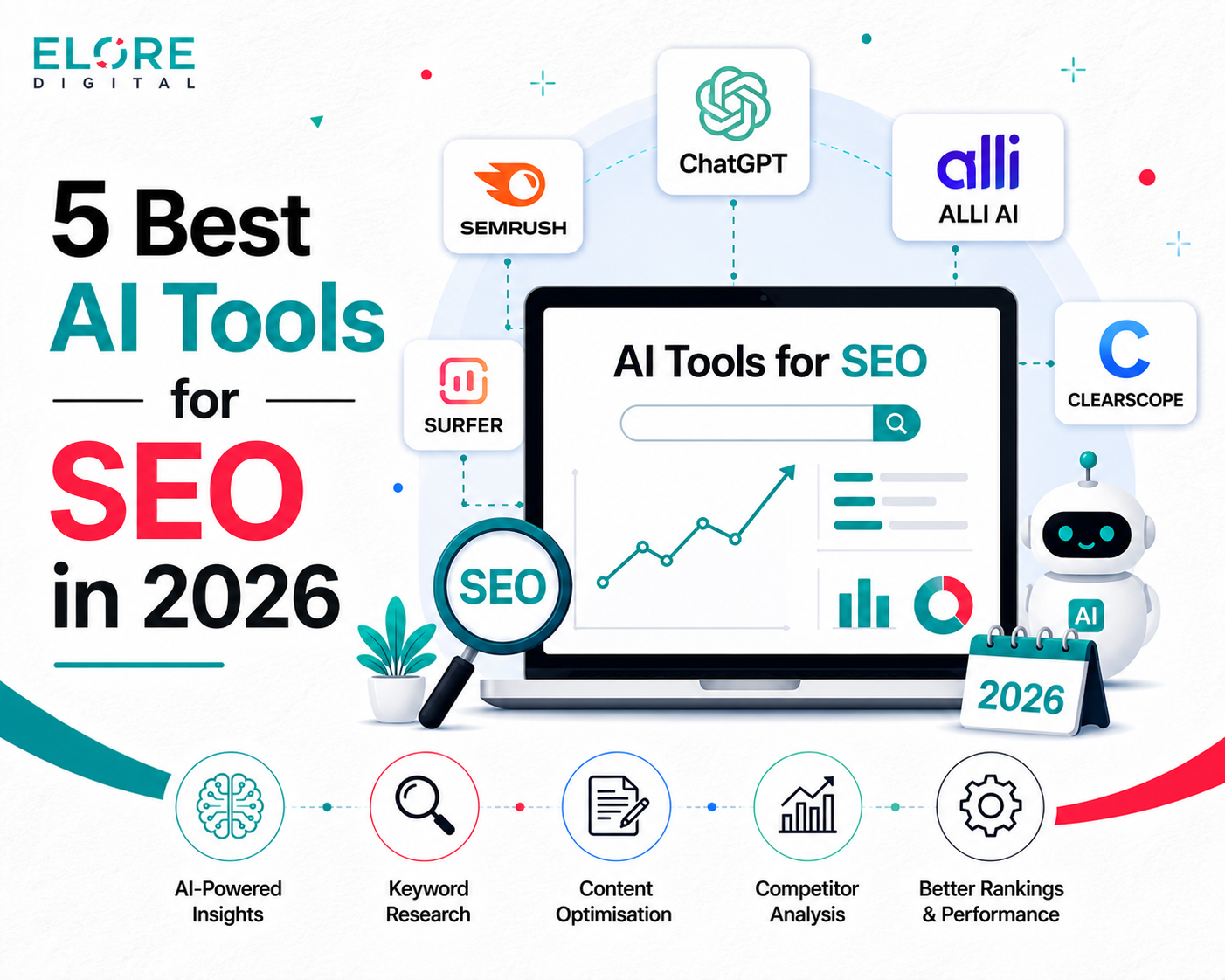
A modern infographic highlighting the top AI tools for SEO in 2026, showcasing how platforms like ChatGPT, SEMrush, Alli AI, Surfer, and Clearscope help improve rankings, optimise content, and drive better search performance
SEO in 2026 is not what it used to be. Gone are the days when you could stuff a few keywords into a blog post, press publish, and watch the traffic roll in. Today, search engines are smarter, competition is stronger, and the rules keep changing almost every month. But here is the good news: AI tools have completely changed the game, and if you are not using them yet, you are seriously leaving money on the table.
Whether you are a student trying to grow your first blog, a young entrepreneur building a brand, or a content creator chasing that viral moment, this guide is for you. We tested the tools, did the research, and put together the most useful breakdown of the 5 best AI tools for SEO in 2026. So grab your coffee, get comfortable, and read on.
1. The Rise of AI in SEO: A 2026 Overview
Artificial intelligence has moved from being a buzzword to becoming the actual backbone of modern SEO. In this section, we look at how AI reshaped the search landscape, why old school tactics no longer cut it, and what this shift means for your content strategy going forward. Understanding where SEO stands today is the first step to building a strategy that actually works.
1.1 How AI Has Transformed the SEO Landscape
If you have been following the digital marketing world even casually, you already know that AI did not just knock on the door of SEO. It basically walked right in and rearranged all the furniture. Just a few years ago, SEO was mostly a manual game: keyword research spreadsheets, backlink chasing, and hoping Google would notice your content. Now, AI tools can analyze thousands of data points in seconds, suggest content improvements in real time, and even predict what your audience is going to search for next.
It is like having a brilliant marketing team working for you around the clock, except it fits inside your laptop. The transformation has been so fast that marketers who have not adapted are already falling behind. For the young generation especially, this is actually great news because you get to grow up with these tools and use them right from day one.
1.2 Why Traditional SEO Strategies Are No Longer Enough
Here is a hard truth: the old playbook is dead. Writing generic 500 word articles, buying cheap backlinks, and targeting broad keywords does not work anymore. Google's algorithm is smart enough to see right through it. Search engines now prioritize experience, expertise, authority, and trustworthiness, which is what they call E-E-A-T. Users want real answers, useful content, and genuine value, not filler.
If your content does not solve a real problem or answer a real question, it simply will not rank. The good news is that
AI SEO tools are specifically designed to help you meet these new standards without spending years becoming an SEO expert yourself. You just need the right tools and the willingness to use them properly.
1.3 The Growing Role of Machine Learning in Search Algorithms
Google's search algorithm is no longer just a set of rules. It is a living, learning system powered by machine learning models like RankBrain and MUM. These models understand context, user intent, and even the meaning behind a search query. So when someone types best budget phone for college student, Google does not just look for those exact words. It understands the full picture of what that person actually needs.
This means your content needs to be contextually rich, not just keyword stuffed. Machine learning has also made voice search and visual search more powerful than ever, changing how people find information online. Understanding this shift is the first step to building an SEO strategy that genuinely works in 2026.
1.4 What to Expect From AI Powered SEO in the Coming Years
The future of AI in SEO is genuinely exciting if you are paying attention. We are already seeing tools that can write, optimize, publish, and monitor content with minimal human input. Personalization is becoming a major factor as search results start looking different for different users based on their history, location, and behavior.
AI is also making predictive SEO possible, meaning you can start ranking for topics before they even become trending. For young creators and marketers, this means the barrier to entry is lower than ever before. You do not need a massive budget to compete with big brands anymore. All you need is the right AI tools and the willingness to learn how to use them well.
2. What Makes an AI SEO Tool Truly Effective in 2026?
With hundreds of AI SEO tools flooding the market, choosing the right one can feel like finding a needle in a haystack. Not every tool that claims to be AI powered actually delivers results. In this section, we break down the key features that separate genuinely effective tools from the ones that just look good on a landing page. Use this as your checklist before spending a single dollar.
2.1 Key Features to Look for in an AI SEO Tool
Not all AI SEO tools are created equal, and with so many options flooding the market, it is easy to feel overwhelmed. The best tools in 2026 come with a combination of features like real time content scoring, NLP based keyword suggestions, competitor gap analysis, and technical SEO auditing. You also want something with a clean and user friendly interface because nobody wants to spend three hours figuring out a dashboard when they could be creating content.
Look for tools that offer clear, actionable insights and not just data dumps that leave you more confused than before. A good AI SEO tool should feel like a smart assistant, not a complicated software program. The simpler and more intuitive it is, the faster you will start seeing real results.
2.2 How to Evaluate AI Tools Based on Your Business Needs
Before you invest in any SEO tool, you need to ask yourself a few honest questions. What is your primary goal: more traffic, better rankings, stronger content, or all three? Are you a solo blogger, a small business owner, or part of a larger marketing team? How tech savvy are you, and how much time can you realistically dedicate to learning a new tool?
The answers to these questions will help you narrow down your options significantly. A freelance writer does not need the same enterprise level features as a digital marketing agency managing 50 clients. Being honest about your needs upfront will save you both money and frustration in the long run.
2.3 Free vs Paid AI SEO Tools: Which Is Worth It?
This is the question everyone asks, especially when you are just starting out and watching every dollar. The truth is free tools can get you started, but they almost always come with serious limitations including restricted data, fewer features, and usage caps that kick in right when you need them most. Paid tools offer deeper insights, more accurate data, and features that can genuinely move the needle for your SEO performance.
Think of it this way: free tools are like a bicycle and paid tools are like a car. Both get you somewhere, but one gets you there much faster and with far less effort. If you are serious about growing online, investing in at least one solid paid AI SEO tool is absolutely worth it. Start small, track your results, and scale up as your traffic and revenue grow.
2.4 Integration Capabilities With Existing Marketing Tools
One thing that separates a good AI SEO tool from a great one is how well it works with the other tools you already use. In 2026, most successful content creators and marketers use a combination of tools including Google Analytics, WordPress, Notion, HubSpot, and Slack. If your SEO tool cannot connect with these platforms, you end up wasting time manually copying data between systems.
The best AI SEO tools offer seamless integrations, browser extensions, and API access so everything works together smoothly. This kind of connected workflow does not just save time. It gives you a much more complete picture of your overall marketing performance. Always check the integrations list before committing to any tool.
3. Tool 1: Surfer SEO for AI Driven Content Optimization
Surfer SEO has earned its reputation as the go to content optimization tool for writers, bloggers, and agencies around the world. It takes the guesswork out of on page SEO by giving you live data driven feedback as you write. Whether you are crafting a 500 word product description or a 3000 word pillar post, Surfer tells you exactly what your content needs to rank. Here is a full look at what it offers and who it is built for.
3.1 Overview and Core Features of Surfer SEO
Surfer SEO has established itself as one of the most popular AI content optimization tools available, and for very good reason. At its core, Surfer analyzes the top ranking pages for any given keyword and gives you a real time content score based on hundreds of ranking factors. It tells you exactly how many words to write, which terms to include, how to structure your headings, and even what images to use.
The Content Editor feature is especially loved by writers because it feels natural to use, almost like having an SEO coach sitting right next to you as you type. Surfer also includes a keyword research tool, an SEO audit feature, and a growing suite of AI writing capabilities. For anyone serious about creating content that ranks, Surfer SEO is practically a must have.
3.2 How Surfer SEO Uses AI for On Page Optimization
What makes Surfer stand out is its data driven approach to on page SEO. Instead of guessing what Google wants, Surfer reverse engineers the top results and shows you the common patterns among them. It uses Natural Language Processing to identify semantically related terms that you should include in your content for better topical authority.
The AI scoring system updates in real time as you write, so you are always getting live feedback on how your content performs against competitors. It even flags over optimization, which is just as important as under optimization in today's algorithm. Essentially, Surfer takes the guesswork out of on page SEO and replaces it with hard data and smart suggestions.
3.3 Real World Results and Performance Metrics
Surfer SEO has been used by thousands of content creators, agencies, and brands worldwide, and the results speak for themselves. Many users report significant ranking improvements within just a few weeks of using the Content Editor consistently. Digital marketing agencies have used Surfer to scale content production for clients while maintaining high quality and strong rankings across competitive niches.
Solo bloggers have grown their organic traffic from zero to tens of thousands of monthly visitors using nothing but Surfer optimized content. The tool's ability to combine data analysis with practical writing guidance makes it particularly useful for creators who want results without getting lost in technical complexity. For young content creators, it is one of the most beginner friendly yet powerful tools available today.
3.4 Pricing Plans and Who Surfer SEO Is Best For
Surfer SEO offers several pricing tiers to suit different needs and budgets. The Essential plan is great for individuals and small blogs, while the Scale plan caters to growing businesses and agencies handling multiple projects. There is also an Enterprise option for large teams with advanced needs and custom requirements.
Prices start at around $89 per month, which might feel like a stretch at first, but consider the return on investment when your content starts ranking and driving consistent organic traffic. Surfer is best suited for bloggers, content writers, SEO freelancers, and small to mid sized marketing teams. If writing optimized content is a core part of your strategy, Surfer SEO will likely pay for itself within the first month.
4. Tool 2: Semrush AI for All in One SEO Intelligence
If Surfer SEO is your writing coach, Semrush is your entire marketing department rolled into one platform. It covers everything from deep keyword research and competitor analysis to full technical site audits and content strategy planning. Semrush has been trusted by millions of marketers for years, and its AI powered upgrades in 2026 have made it more powerful than ever. Here is why it deserves a spot in every serious SEO toolkit.
4.1 Overview and Core Features of Semrush AI
Semrush has been a giant in the SEO world for years, and in 2026, its AI powered features have made it even more useful. It is essentially an all in one marketing platform that covers keyword research, competitor analysis, backlink tracking, site auditing, content marketing, and social media management all under one roof. The AI enhancements added in recent years have made the platform significantly smarter.
It can now generate content briefs, suggest topic clusters, and even predict keyword difficulty trends over time. For someone who wants one tool that does everything, Semrush is very hard to beat. The sheer volume of data it provides can feel overwhelming at first, but once you get the hang of it, it becomes your go to marketing command center.
4.2 AI Powered Keyword Research and Competitor Analysis
Keyword research is where Semrush truly shines, and the AI upgrades have made it even more powerful. You can enter a seed keyword and instantly get hundreds of variations, questions, long tail phrases, and trend data, all filtered by difficulty, search volume, and user intent. The competitor analysis feature lets you look into your rivals' strategies, showing you exactly which keywords they are ranking for, what their top pages are, and where their backlinks are coming from.
This kind of competitive intelligence used to require a team of analysts and weeks of research. Now you get it in minutes. For young entrepreneurs and marketers, this levels the playing field significantly. You can essentially study the success of bigger brands and find gaps they have completely missed.
4.3 Content Marketing Toolkit and Topic Clustering
Semrush's Content Marketing Toolkit is a hidden gem that not enough people talk about. It includes a Topic Research tool that generates hundreds of related content ideas based on your main topic, helping you build a complete content strategy from scratch. The SEO Content Template feature analyzes top ranking content and gives you a detailed blueprint to follow for each piece you write.
Topic clustering, which means grouping related content together to build topical authority, is made incredibly simple with Semrush's visual mapping tools. This is a major advantage for bloggers and website owners who want to rank for entire topics, not just individual keywords. Pairing this toolkit with consistent publishing is one of the fastest ways to grow organic traffic in 2026.
4.4 Pricing Plans and Who Semrush Is Best For
Semrush is not the cheapest tool on this list, but it is one of the most comprehensive. Plans start at around $129 per month for the Pro plan, which is suitable for freelancers and startups. The Guru plan at around $249 per month adds historical data, content marketing tools, and more advanced features. For large agencies and enterprises, the Business plan offers even more user seats and API access.
Yes, the price tag is significant, but no other tool on this list offers the same breadth of features in one place. Semrush is best for digital marketers, SEO agencies, e commerce businesses, and anyone who needs a complete and data rich view of their online presence. Their free trial is also worth exploring before you commit to a paid plan.
5. Tool 3: Clearscope for Content Relevance and Rankings
Clearscope does one thing, and it does it better than almost anyone else: it helps your content achieve genuine topical relevance in the eyes of Google. Instead of just chasing keywords, Clearscope helps you build depth and context into every piece you publish. It is the tool of choice for content teams that take quality seriously and want their articles to hold their rankings long term. Here is a closer look at how it works and who it is built for.
5.1 Overview and Core Features of Clearscope
Clearscope is the go to tool for content teams that are focused on quality and relevance, and in 2026, that focus pays off big time. The platform focuses specifically on content optimization, using AI and NLP to help writers create pieces that are both search engine friendly and genuinely useful to readers. When you enter a target keyword, Clearscope generates a detailed report showing the most important terms to include, competitor benchmarks, and a real time content grade.
It is clean, fast, and incredibly focused. There are no distractions, just pure content optimization. Unlike some tools that try to do everything, Clearscope stays in its lane and does its one job extremely well. For writers and content strategists who care about quality over quantity, it is a great tool to have in your workflow.
5.2 How Clearscope Improves Content Grading and NLP Optimization
Clearscope's content grading system is one of the most intuitive in the industry. It assigns letter grades to your content based on how well it covers the topic compared to top ranking competitors. The NLP powered term suggestions go beyond simple keyword matching. They identify concepts and themes that Google associates with your target topic, helping you build genuine topical depth.
This approach aligns perfectly with how modern search algorithms evaluate content, making Clearscope optimized articles significantly more likely to rank and stay ranked over time. The tool also measures readability, making sure your content is accessible to your target audience. For young writers, this kind of real time feedback is like having a professional editor and SEO expert reviewing your work at the same time.
5.3 Workflow Integration With Google Docs and WordPress
One of the things users love most about Clearscope is how smoothly it connects with existing writing workflows. The Google Docs integration is particularly impressive. You can optimize your content directly inside Google Docs without ever switching tabs or copying text around. The WordPress plugin brings the same functionality directly into the WordPress editor, making it perfect for bloggers and website owners who publish frequently.
These integrations remove the friction that usually comes with adopting a new tool, making it much easier to build consistent optimization habits. For remote teams and collaborative content workflows, this kind of seamless connectivity is genuinely valuable. It shows that Clearscope truly understands how modern content teams actually work.
5.4 Pricing Plans and Who Clearscope Is Best For
Clearscope sits at the premium end of the pricing range, with plans starting around $170 per month. This might seem steep, but it is designed for professional content teams where content quality directly impacts revenue. The platform is best suited for content marketing agencies, in house SEO teams, and serious bloggers who publish regularly and need consistent, high quality results.
If you are a solo creator just starting out, the price might be a barrier right now, but many teams find that even one well optimized article that lands on the first page of Google can justify the entire cost. Clearscope also offers team plans with multiple seats, making it more cost effective for larger groups. If content quality is your top priority, Clearscope is worth every penny.
6. Tool 4: Alli AI for Automated Technical SEO at Scale
Most SEO tools focus on content, but Alli AI goes straight to the technical engine of your website. It automates the complex and time consuming parts of technical SEO that most people avoid simply because they do not know where to start. From fixing broken meta tags to deploying site wide changes without touching a single line of code, Alli AI is built for speed, scale, and simplicity. Here is everything you need to know about it.
6.1 Overview and Core Features of Alli AI
Alli AI is the kind of tool that technical SEO professionals dream about, but it is actually built to be accessible to everyone, even if you have never touched a single line of code in your life. It is designed to automate the most tedious and complex parts of technical SEO, like fixing meta tags, optimizing page speed, implementing schema markup, and updating site wide SEO settings without needing a developer.
You simply connect your website, and Alli AI crawls it, identifies issues, and lets you fix them with just a few clicks. For anyone managing a large website or multiple client sites, this kind of automation is a real lifesaver. The tool works across all major CMS platforms including WordPress, Shopify, and Wix. In 2026, technical SEO is more important than ever, and Alli AI makes it manageable for everyone.
6.2 Automating On Site SEO Changes Without Developer Help
The biggest selling point of Alli AI is its ability to make on site SEO changes without requiring any technical knowledge or developer involvement. You can deploy site wide title tag changes, meta description updates, and internal linking improvements across thousands of pages in minutes. These are tasks that would normally take a developer several days to complete.
The AI automatically identifies the highest priority fixes and guides you through implementing them in the most efficient order. This is particularly powerful for small businesses and solo entrepreneurs who cannot afford to hire a full time developer or SEO specialist. The tool also includes A/B testing for SEO changes, so you can see what actually works before rolling it out across your entire site.
6.3 Bulk SEO Optimization for Large Websites and Agencies
For agencies and large e commerce sites managing hundreds or thousands of pages, Alli AI's bulk optimization features are a real advantage. You can set up optimization rules that automatically apply to new pages as they are published, ensuring consistent SEO quality across your entire site without manual effort. The multi site management dashboard makes it easy to oversee SEO performance across multiple client websites from one central location.
Alli AI also connects with major analytics platforms, giving you a complete picture of how your technical improvements are impacting rankings and traffic. For agencies looking to scale their SEO services without increasing their workload, this tool delivers serious efficiency gains. It is the kind of automation that genuinely lets you do more with less.
6.4 Pricing Plans and Who Alli AI Is Best For
Alli AI offers flexible pricing based on the number of websites and pages you need to manage. Plans start at around $299 per month, which is positioned at the higher end of the market, but the value becomes clear when you consider the developer time and manual effort it replaces. There are plans for small businesses, growing agencies, and enterprise level operations, each with increasing levels of automation and support.
The tool is best suited for digital marketing agencies, e commerce store owners, and SEO professionals managing large or complex websites. If you are a solo blogger with a small site, Alli AI might be more than you need right now. But if you are managing sites at scale, it is one of the most cost effective investments you can make in your SEO operation.
7. Tool 5: ChatGPT for SEO Strategy and Content Creation
ChatGPT might not be a traditional SEO tool, but in 2026 it has quietly become one of the most used tools in the SEO workflow of creators, marketers, and agencies worldwide. From brainstorming content ideas to drafting entire articles in minutes, ChatGPT adds speed and flexibility to every stage of the content process. When used correctly and paired with dedicated SEO tools, it becomes a serious productivity multiplier. Here is how to use it effectively.
7.1 How ChatGPT Is Used in SEO Workflows
You might be surprised to see ChatGPT on this list since it is not technically an SEO specific tool, but in 2026, it has become an essential part of countless SEO workflows around the world. From generating keyword ideas and writing meta descriptions to creating content outlines and drafting full blog posts, ChatGPT can handle an enormous range of SEO related tasks with great speed.
The key is knowing how to use it as part of a larger strategy rather than treating it like a magic content machine. When combined with proper SEO tools and human editing, ChatGPT can dramatically speed up your content production without sacrificing quality. For young creators on a budget, it is one of the most accessible and versatile AI tools available today. Think of it as your always available creative partner.
7.2 Prompt Engineering Techniques for SEO Content
Getting the most out of ChatGPT for SEO comes down to one core skill: prompt engineering. The better your prompts, the better your outputs. That is simply how it works. Instead of asking write a blog post about fitness, try something like: write a 1500 word SEO optimized blog post targeting the keyword home workout routine for beginners, with a conversational tone, practical tips, and clear subheadings. Specificity is everything.
You can also use ChatGPT to generate keyword clusters, identify content gaps, create FAQ sections, write schema markup, and study competitor content strategies. Learning to write powerful prompts is genuinely one of the most valuable digital skills you can develop in 2026. The creators who master this skill will have a serious advantage over everyone who does not.
7.3 Limitations of Using ChatGPT as a Standalone SEO Tool
As powerful as ChatGPT is, it is important to understand its limitations so you do not rely on it for things it simply cannot do well. ChatGPT does not have real time access to search data, keyword volumes, or competitor analytics. It cannot tell you what is actually ranking right now or how competitive a keyword is. Its training data has a cutoff, meaning it may not always be aware of the latest algorithm updates or industry trends.
Content generated only by ChatGPT, without proper optimization and human editing, can also feel generic and may struggle to rank against well optimized, experience driven content. It also cannot crawl your website, run technical audits, or provide fixes for site issues. Used alone, it is a powerful writing assistant. But it needs to be paired with dedicated SEO tools to reach its full potential.
7.4 Combining ChatGPT With Other AI SEO Tools for Better Results
The real results come when you combine ChatGPT with purpose built SEO tools. Here is a workflow that many successful creators use in 2026: start with Semrush to identify the best keywords and study competitors, then use Surfer SEO's Content Editor to get an optimization brief, then use ChatGPT to draft the content quickly, and finally run it through Clearscope to make sure it hits all the right topical notes before publishing.
This combination gives you the speed of AI content creation plus the accuracy of data driven SEO optimization. It is not about replacing human creativity. It is about using AI to handle the heavy lifting so you can focus on strategy and storytelling. Build your own custom workflow and keep refining it as you learn what works best for your niche.
8. The Future of AI and SEO: Trends to Watch Beyond 2026
SEO is not a destination. It is a constantly moving target, and the AI revolution is only accelerating that pace of change. The strategies and tools that work brilliantly today may look completely different two or three years from now. In this final section, we look at the biggest trends shaping the future of AI and SEO so you can stay one step ahead and future proof your content strategy before others even see the changes coming.
8.1 Voice Search, Visual Search, and AI's Expanding Role
Voice search and visual search are no longer niche features. They are becoming mainstream ways that people, especially younger generations, discover content and products online. With the rise of AI assistants, smart speakers, and image based shopping, optimizing for these search types is becoming increasingly important. Voice search optimization means focusing on conversational, question based keywords and content that is worthy of featured snippets.
Visual search requires high quality images with proper alt text, schema markup, and fast loading speeds. AI tools are already beginning to incorporate optimization recommendations for both voice and visual search into their feature sets. Staying ahead of these trends now will give you a meaningful competitive advantage as they continue to grow in the coming years.
8.2 How Google's AI Updates Will Shape SEO Strategies
Google's use of AI in its search experience, most notably through features like AI Overviews and the Search Generative Experience, is fundamentally changing what it means to rank on the first page. In some cases, AI generated summaries now appear above traditional organic results, which means even ranking at the top might not generate the traffic it once did. This shift is pushing SEO professionals to rethink their strategies and focus more on building brand authority and earning mentions in AI generated responses.
The good news is that genuinely helpful, well written content is still being rewarded, perhaps more than ever before. Adapting your strategy to work with Google's AI rather than against it is the smartest move you can make for long term success. Focus on creating content that truly serves your readers, and the rankings will follow.
8.3 The Ethics of AI Generated Content in Search Rankings
As AI content generation becomes more widespread, the conversation around ethics and authenticity is getting louder and more important. Google has made it clear that it rewards helpful, high quality content regardless of whether it was written by a human or AI, but it also penalizes low quality, spammy, or misleading content regardless of its source. The ethical use of AI in SEO means using these tools to improve and speed up your work, not to flood the internet with meaningless auto generated articles.
Adding your unique voice, real world experience, and genuine expertise to AI assisted content is what separates the creators who win from those who get filtered out. As a young creator, your authentic perspective is your biggest competitive advantage. Do not let AI remove that from your content.
8.4 Preparing Your SEO Strategy for the Next Wave of AI Innovation
The pace of AI innovation is only going to accelerate, which means the SEO landscape will keep changing in ways we cannot fully predict right now. The best preparation you can make is to build a strong foundation of SEO fundamentals including understanding user intent, creating genuinely valuable content, building real authority in your niche, and keeping a technically sound website. These fundamentals do not change even when the tools and algorithms do.
Stay curious, keep learning, follow industry thought leaders, and try out new tools as they emerge. The young creators who will dominate SEO in 2028 and beyond are the ones who are learning and adapting right now. Treat every algorithm update and every new AI tool as an opportunity, not something to be afraid of.
Conclusion
The 5 best AI tools for SEO in 2026 each offer something valuable, from content optimization and keyword research to technical improvements and creative support. Surfer SEO, Semrush, Clearscope, Alli AI, and ChatGPT can help businesses and individuals improve their online presence and grow more effectively. The right tool depends on your goals, budget, and level of experience, but using one or more of these tools can give you a strong advantage. AI is not replacing SEO; instead, it is making SEO more powerful, efficient, and accessible, especially for those who learn to use these tools effectively.


Leave A Reply