30 Jan 2026 • 6 Minutes Read
Written by Elore Digital Team
How AI-Driven Creativity Is Transforming Brand Storytelling
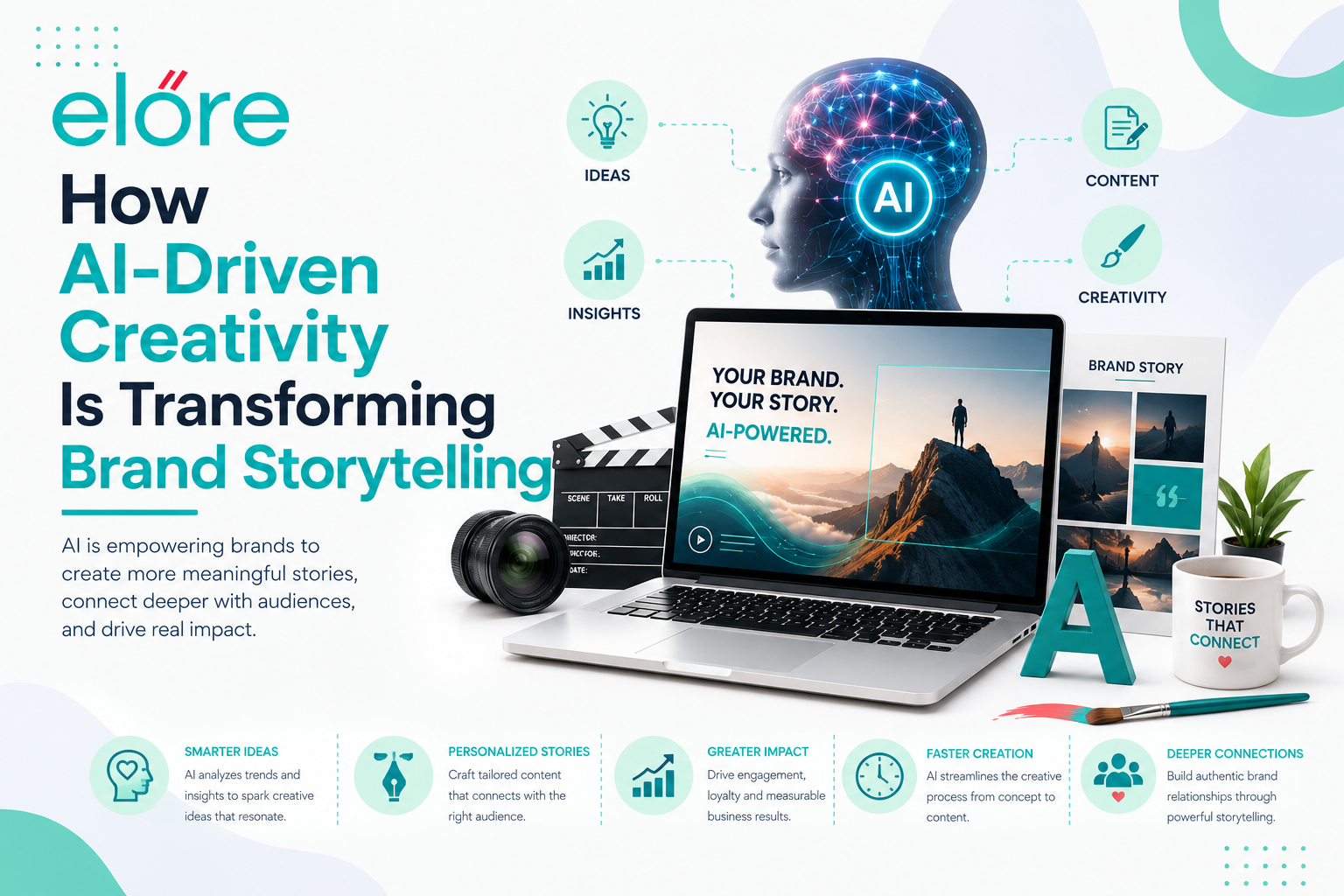
How AI-Driven Creativity Is Transforming Brand Storytelling empowering brands to create smarter ideas, personalized stories, and deeper audience connections with AI.
The Rise of AI as a Creative Force
Artificial intelligence has moved beyond being a backend marketing tool. What began as a way to analyse performance metrics and automate workflows has evolved into something far more influential — AI-driven creativity.
Today, brands are using AI to generate ideas, shape narratives, and design experiences that feel personal, timely, and emotionally relevant. From AI creative content generation to real-time personalisation, creativity is no longer limited by time, scale, or manual effort.
This shift is redefining how stories are created and consumed. Instead of producing a single campaign for a broad audience, brands can now craft thousands of story variations that adapt to individual preferences and behaviour. The result is not just efficiency, but deeper emotional connection.
As competition for attention increases, AI in brand storytelling is becoming less of an experiment and more of a necessity. The brands that understand how to combine intelligence with imagination are the ones shaping the future of marketing.
Why Brand Storytelling Is the Next Frontier for AI Innovation
Brand storytelling has always been about emotion — trust, aspiration, identity, and belonging. But modern audiences expect more than well-written narratives. They want relevance, authenticity, and personalisation at every touchpoint.
This is where brand storytelling strategies with AI are creating a major shift.
Traditional storytelling relied heavily on intuition and static personas. While creative instincts still matter, they are no longer enough on their own. AI enables marketers to understand audience intent at a deeper level by analysing behaviour, sentiment, and engagement patterns in real time.
With AI, storytelling becomes:
- Personal, adapting to individual users rather than segments
- Predictive, anticipating emotional responses before content is published
- Dynamic, evolving as audience behaviour changes
Instead of broadcasting a fixed message, brands can now design narratives that respond to how people feel and interact. This is why many marketers see AI-driven brand storytelling as the next major innovation in customer experience.
The goal is not to replace creativity, but to support it with intelligence — allowing stories to scale without losing their human touch.
What Is AI-Driven Creativity?
What is AI-driven brand storytelling?
AI-driven creativity refers to the use of artificial intelligence to assist, enhance, or inform the creative process — from ideation and storytelling to design and content delivery.
Unlike traditional automation, which focuses on repetitive tasks, AI creativity in marketing supports decision-making and interpretation. It helps creators understand what resonates, why it resonates, and how stories can be refined for different audiences.
In practical terms, AI-driven creativity allows brands to:
- Generate content ideas based on audience intent
- Personalise narratives using behavioural and emotional data
- Optimise storytelling formats across platforms
AI-Driven Creativity in Marketing and Advertising
How does AI help with creative marketing?
In marketing and advertising, AI is used to analyse cultural trends, identify emotional triggers, and suggest storytelling approaches that align with audience expectations.
This has led to the rise of AI storytelling tools for marketers, which support:
- Personalised campaigns
- Adaptive messaging
- Consistent brand voice across channels
Rather than removing human input, AI acts as a creative partner — providing insights and recommendations that make storytelling more informed and effective.
As a result, brands are not just telling better stories; they are telling stories that feel more relevant, timely, and human.
Core Technologies Powering AI-Driven Creativity
AI-driven creativity is not powered by a single system, but by a combination of technologies that work together to support storytelling, design, and personalisation. Understanding these foundations helps brands use AI more strategically — not just tactically.
Generative AI and Creative Content Generation
Generative AI for brand narratives enables marketers to produce text, images, and concepts at scale. These systems are trained on vast datasets and can generate creative outputs that align with brand tone, style, and messaging guidelines.
For brand storytelling, generative AI supports:
- Drafting narrative frameworks and campaign concepts
- Creating variations of messaging for different audiences
- Speeding up experimentation during the creative process
This form of
AI creative content generation reduces friction in ideation, allowing creative teams to focus more on strategy, emotion, and refinement.
Natural Language Processing and Emotional Understanding
Natural Language Processing (NLP) plays a critical role in how AI understands and responds to human communication. It enables systems to detect intent, tone, and sentiment across customer interactions.
In the context of storytelling, NLP supports:
- Consistent brand voice across platforms
- Emotion-aware messaging
- Improved conversational experiences
This capability is essential for developing AI emotional intelligence in brand stories, helping brands communicate with empathy rather than automation.
Computer Vision and Visual Storytelling
Computer vision allows AI to interpret and generate visual content that aligns with brand identity. From analysing images to creating visuals that match aesthetic guidelines, it is transforming
AI-generated visuals for brand campaigns.
For marketers, this means visuals can be:
- Adapted based on audience engagement
- Optimised for different platforms
- Aligned with real-time trends
Together, these technologies turn data into creative input, enabling storytelling that is both intelligent and expressive.
Human + AI Collaboration: Redefining Creative Work
A common concern in modern marketing is the perceived tension between machines and imagination. The discussion around
AI vs human creativity in marketing often frames AI as a replacement rather than an enhancement.
In reality, the most effective results come from collaboration.
AI brings:
- Speed and scalability
- Pattern recognition across large datasets
- Predictive insights into audience behaviour
Humans bring:
- Empathy and cultural context
- Ethical judgement
- Original vision and storytelling intuition
Understanding the
difference between AI automation and creativity is crucial. Automation executes tasks; AI-driven creativity informs decisions. When used correctly, AI frees creative teams from repetitive work and gives them more space to focus on narrative depth and emotional resonance.
This partnership is reshaping how campaigns are built — transforming creative teams into AI-augmented storytellers who can move faster without sacrificing quality or authenticity.
The Evolution of Brand Storytelling in the AI Age
Brand storytelling has always evolved alongside technology. What sets the AI era apart is the shift from static narratives to responsive, intelligent storytelling systems.
From Traditional Storytelling to Intelligent Narratives
Traditional storytelling models relied on fixed messages and predefined audience personas. While effective in the past, they struggle to meet modern expectations for personalisation.
How does AI personalise brand stories?
AI analyses real-time behaviour, preferences, and sentiment to tailor stories for each individual. This allows brands to move from one-size-fits-all campaigns to brand narrative personalisation with AI.
Stories are no longer linear — they adapt based on how audiences engage, creating more relevant and meaningful experiences.
Data as the New Creative Canvas
Data has become a central ingredient in storytelling, not just a measurement tool.
How AI predicts audience emotions is what enables
adaptive storytelling with AI technology. By identifying emotional patterns and engagement signals, AI helps brands adjust narratives to better match audience mood and context.
This approach supports:
- More accurate emotional alignment
- Faster creative optimisation
As a result, brand storytelling is shifting from intuition-led decisions to intelligent narrative design — where creativity is guided by insight rather than guesswork.
Brands Already Using AI Storytelling
What are examples of AI in brand narrative?
AI-driven storytelling is no longer theoretical — leading brands are already using it to create personalised, emotionally engaging experiences.
Coca-Cola: Co-Creation and Community Engagement
Coca-Cola leveraged generative AI for brand narratives in its “Create Real Magic” campaign. Consumers were invited to co-create digital art using AI tools, turning the audience into active storytellers. This approach increased engagement and showcased the potential of AI emotional intelligence in brand stories.
Nike: Personalised Product Storytelling
Nike uses AI to deliver brand narrative personalisation with AI. From app notifications to social media campaigns, stories adapt to each customer’s journey. The result is content that feels hand-crafted at scale, demonstrating the power of AI creativity in marketing.
Cadbury: Hyper-Personalised Video Campaigns
Cadbury implemented AI to generate localised, personalised video ads featuring regional celebrities. This is a prime example of
AI-generated visuals for brand campaigns and shows how data-driven insights enable stories to resonate with diverse audiences.
These examples prove that AI-driven brand storytelling isn’t just a concept — it’s a practical, scalable, and emotionally effective tool for marketers.
The Emotional Intelligence of Machines
How does AI improve storytelling for brands?
AI is no longer just a data-crunching engine. Advances in NLP and sentiment analysis allow machines to understand tone, emotion, and context, making storytelling more human-centred.
AI Detects Emotion
By analysing language patterns, social media posts, and even facial expressions in video content, AI can anticipate how audiences will respond emotionally. This enables:
- Emotion-aware messaging
- Personalised narrative adjustments
- More impactful content engagement
AI Creates a Dialogue, Not Just a Story
Modern brand storytelling moves from broadcasting to co-creating with audiences. AI allows brands to:
- Respond in real time
- Adjust campaigns based on feedback
- Maintain consistent brand voice across platforms
This marks the rise of truly intelligent, adaptive storytelling with AI technology, where machines help brands connect on an emotional level without replacing the human touch.
Benefits of AI-Driven Brand Storytelling
Why use AI for brand storytelling?
The advantages of integrating AI into creative workflows are both strategic and operational:
Personalisation at Scale
AI allows brands to tailor content for each audience member, achieving a level of relevance previously impossible. This is why AI storytelling tools for marketers are now essential.
Faster Creative Iteration
Generative AI accelerates ideation, prototyping, and campaign testing. Teams can explore multiple narrative approaches in hours instead of weeks.
Higher Engagement and Emotional Resonance
By combining predictive analytics with creative insight, brands can deliver stories that resonate with emotion, context, and cultural nuance. This is the essence of AI emotional intelligence in brand stories.
Consistency Across Channels
AI ensures messaging and visuals are aligned with brand identity across platforms, which is key for maintaining trust and recognition.
In short, AI-driven brand storytelling not only enhances efficiency but also elevates the quality and impact of creative marketing.
The Future of Brand Storytelling with AI
What is the future of marketing with AI creativity?
AI-driven creativity is evolving beyond simple personalisation. Brands are now exploring predictive and immersive storytelling that anticipates audience behaviour and adapts in real time.
Predictive and Adaptive Storytelling
AI can forecast audience preferences and emotional responses, allowing brands to adjust narratives before content is even consumed. This is the essence of adaptive storytelling with AI technology and ensures campaigns remain relevant and engaging.
Immersive Experiences
From augmented reality (AR) to virtual reality (VR) and the metaverse, AI enables AI-generated visuals for brand campaigns that fully immerse users in interactive narratives. This creates experiences that are memorable, shareable, and highly personalised.
Continuous Optimisation
The future of brand storytelling is iterative. AI tools continuously learn from user interactions, refining messages and visuals to improve emotional resonance and performance over time. Brands that embrace these trends will lead the next generation of marketing innovation.
How Brands Can Get Started with AI-Driven Creativity
How to use AI for creative campaigns?
For brands new to AI-driven storytelling, the path can be straightforward when approached strategically:
- Identify Use Cases
Start with high-impact storytelling areas, such as personalised emails, social campaigns, or product narratives. Focus on where AI can create measurable value.
- Select the Right Tools
Explore AI storytelling tools for marketers that support generative AI, NLP, or computer vision. Choose platforms that integrate easily with existing workflows.
- Upskill Creative Teams
Encourage collaboration between human creators and AI. Understanding the difference between AI automation and creativity is crucial for teams to maximise impact.
- Measure Performance
Track engagement, emotional impact, and conversion metrics to ensure AI-supported campaigns deliver results. Knowing key metrics for AI storytelling performance helps optimise future campaigns.
By taking these steps, brands can leverage AI to create richer, more engaging, and more effective narratives while maintaining authenticity.
Wrap Up: Creativity in the Age of Intelligence
AI is not replacing human creativity — it is amplifying it. By combining human empathy with machine intelligence, brands can craft stories that are personal, dynamic, and emotionally resonant.
AI creativity in marketing enables:
- Personalisation at scale
- Real-time narrative adaptation
- Emotionally intelligent storytelling
Brands that embrace AI today are positioning themselves to lead in tomorrow’s highly competitive landscape, where audiences expect relevance, authenticity, and interaction at every touchpoint.
The future of brand storytelling is not artificial. It is intelligently human, data-driven, and emotionally informed — a partnership between imagination and intelligence that defines the next era of marketing.
Conclusion:
AI-driven creativity is transforming brand storytelling by helping businesses create more personalized, engaging, and meaningful content. From generating creative ideas to understanding audience preferences, AI allows brands to connect with customers in new and effective ways. By combining artificial intelligence with human creativity, businesses can build stronger brand identities and deliver stories that truly resonate with their audiences.





Leave A Reply