05 Aug 2026 • 3 Minutes Read
Written by Elore Digital Team
WhatsApp Usernames vs. Telegram, Signal, and Instagram: What's Actually Different
Usernames aren't new — Telegram, Signal, and Wire have all let people message without exchanging phone numbers for years. What makes WhatsApp's version worth a closer look isn't the concept, it's the scale (over three billion users) and a couple of specific design choices that set it apart from what you might already be used to elsewhere.
The Core Idea Is the Same Everywhere
On every one of these platforms, a username exists to solve the same problem: letting someone contact you without handing over a phone number. If you've used a Telegram or Signal username before, the basic mental model transfers directly — WhatsApp is catching up to an idea its competitors normalized first.
Where WhatsApp's Version Is Different
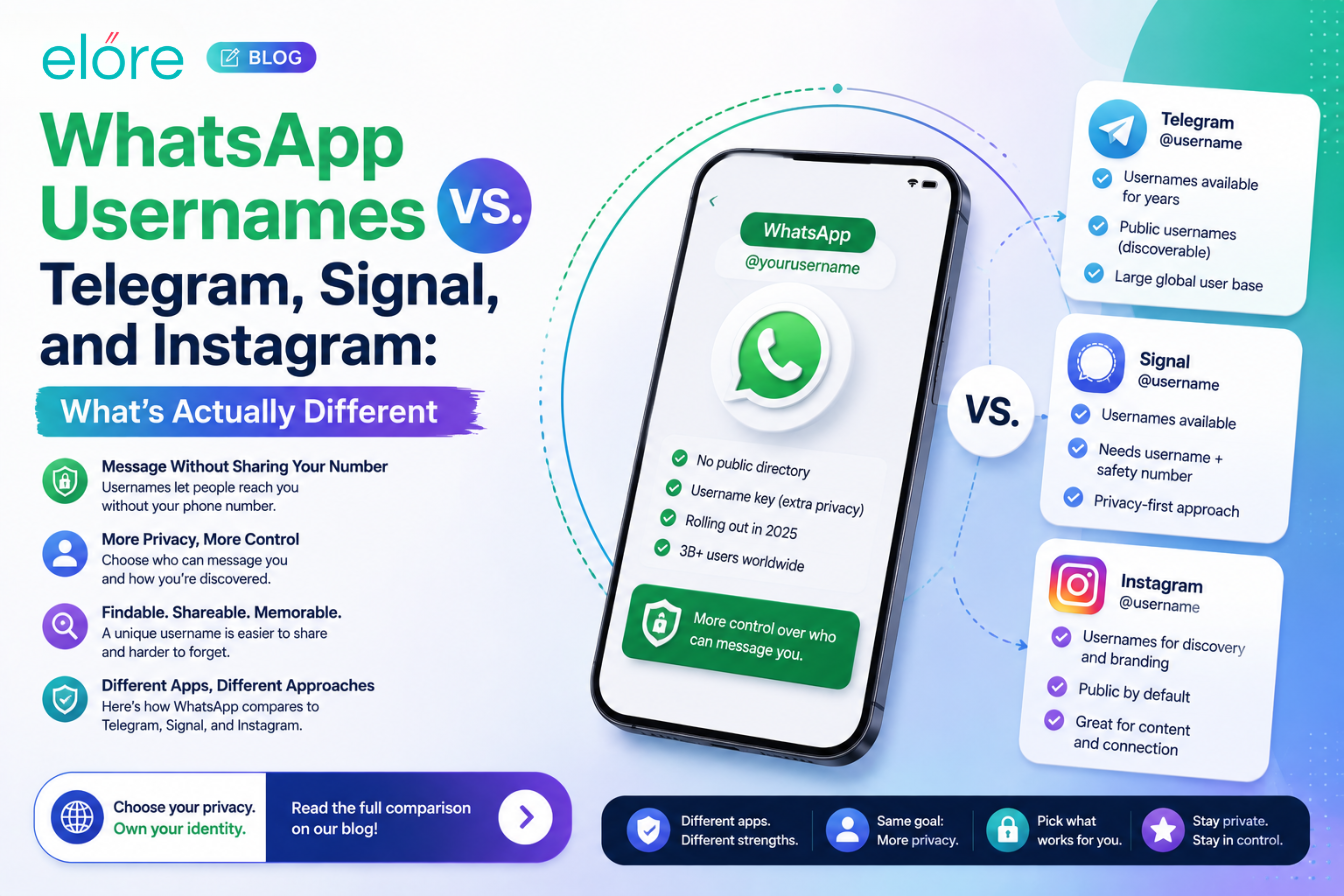
No public directory, by design. Telegram usernames are searchable — type @someone in Telegram's search and, if their privacy settings allow it, you'll find them. WhatsApp deliberately built the opposite: there's no directory and no "people you may know" for usernames. Someone has to already know your exact handle to reach you. It's a stricter, more closed model than Telegram's.
An optional second layer: the username key. WhatsApp is adding something neither Telegram nor Signal offers in quite the same form — an optional key that acts like a passcode on top of your username. Even someone who knows your handle can't message you unless they also have the key, if you've turned this on. It's a more granular privacy control than a straightforward public/private toggle.
A phone number is still mandatory. Signal has moved toward letting usernames be the primary identifier, reducing reliance on phone numbers over time. WhatsApp hasn't gone that far — a phone number is still required to create and log into an account. The username changes what new contacts see, not what WhatsApp itself requires to sign up.
Instagram and Facebook handles carry over automatically. This is unique to WhatsApp's rollout: creators and businesses can claim their existing Instagram or Facebook username directly, and Instagram usernames are pre-reserved for their existing owners so nobody else can take them on WhatsApp. Telegram and Signal have no equivalent tie-in to a Meta-owned social profile.
Quick Comparison
| WhatsApp | Telegram | Signal |
|---|
| Phone number required to sign up | Yes | Yes | Yes |
| Username searchable in a public directory | No | Yes (if allowed) | No |
| Optional extra access key beyond username | Yes | No | No |
| Auto-claim via Instagram/Facebook handle | Yes | No | No |
| Username hides number from new contacts | Yes, if enabled | Yes | Yes |
What This Means If You're Switching Between Apps
If you're used to Telegram's more open, searchable model, WhatsApp's closed approach will feel more restrictive — you can't discover someone by guessing or searching, only by being told their exact handle. If you're coming from Signal, the biggest adjustment is that WhatsApp still leans on your phone number as the account anchor; a username is an added layer, not a replacement.
For businesses running a presence across all three, the practical takeaway is consistency: claim the same handle everywhere you can, and treat WhatsApp's Instagram/Facebook auto-claim as the fastest way to keep that consistent without retyping it three times.
Frequently Asked Questions
Is a WhatsApp username public like a Telegram username?
No. WhatsApp has no public directory or search for usernames — someone needs your exact handle already to contact you, unlike Telegram where usernames can be searchable.
Does WhatsApp still need my phone number if I have a username?
Yes. A phone number is still required to create and log into a WhatsApp account; the username only changes what new contacts see when they message you.
Can I use the same username on WhatsApp as Telegram or Signal?
There's no technical link between the platforms, but nothing stops you from manually choosing the same handle on each, as long as it's available and follows each platform's own rules.
What's the biggest difference between WhatsApp and Signal usernames?
Signal has moved toward usernames as a more central identifier over time, while WhatsApp still requires a phone number as the primary account anchor and treats the username purely as an added privacy layer for new contacts.
 MOST READS


Leave A Reply