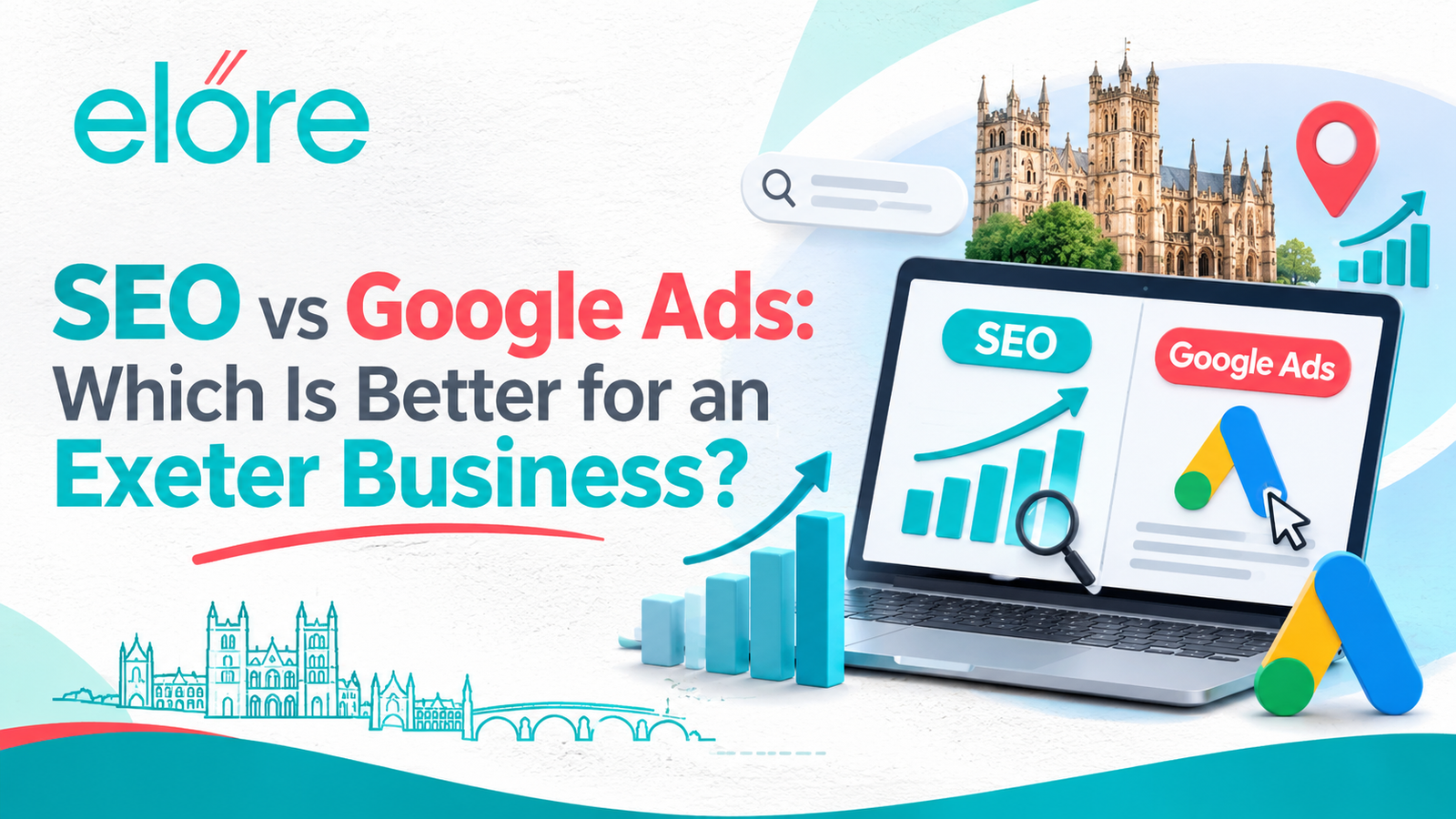
SEO vs Google Ads: Which Is Better for an Exeter Business?
SEO vs Google Ads: Discover which digital marketing strategy is best for growing your Exeter business with Elore Digital.
Share:
More than 200,000 UK firms spent over £10 billion on Google search advertising in 2024, according to the CMA's October 2025 report. That is a lot of money going to one platform. So if you run a small business in Exeter, the real question is simple. Should your money go to SEO vs Google Ads?
The short answer is this. Google Ads gets you customers this week, but only while you pay. SEO takes months, but it keeps working after you stop spending. For most Exeter businesses, the best answer is a planned mix of both, in the right order.
In this guide you'll learn how each channel works, what each one really costs, how long results take, and how to choose based on your business type. You'll also get a simple 90 day plan you can start using today.
Table of Contents
What Is the Difference Between SEO and Google Ads?
How Much Do They Cost for an Exeter Business?
How Fast Do Results Come?
Local SEO Exeter: How to Get Found on Google Maps
Google Ads Exeter: How PPC Works for Local Businesses
Which One Should You Choose? Four Real Examples
How to Use SEO and Google Ads Together
Common Mistakes Exeter Businesses Make
FAQ
Conclusion
What Is the Difference Between SEO and Google Ads?
SEO (search engine optimisation) is the work you do to earn a free spot in Google's normal results. Google Ads is a paid system where you bid to show your ad at the top of those results. One earns visibility, the other rents it.
Think of it like a shop. Google Ads is renting a stall in the busiest part of Exeter High Street. The moment you stop paying rent, you lose the stall. SEO is buying a unit on a good street. It costs more effort at the start, but you own the space.
How SEO Works
SEO makes your website easy for Google to understand and easy for people to trust. It covers three main areas:
Technical SEO: page speed, mobile layout, clean site structure and secure pages.
Content: pages and articles that answer what your customers actually search for.
Authority: links from other trusted websites and good reviews that prove you are real.
When all three improve, you earn more organic traffic, which means visitors who find you without you paying per click.
How Google Ads Works
Google Ads uses a bidding system called pay per click (PPC). You pick keywords, write an ad and set a budget. Each time someone clicks, you pay. The price depends on your bid, how relevant your ad is, and how many other businesses want the same click.
Google gives each ad a Quality Score. A better score means a lower cost per click. So good ads, matched to a good landing page, cost less than sloppy ones.
What Is the Real Difference in One Line?
Google Ads buys you attention today. SEO builds you a reputation that lasts. Neither is better in every case. They solve different problems.
How Much Do SEO and Google Ads Cost for an Exeter Business?
Google Ads costs vary hugely by trade, while SEO costs are mostly a monthly fee for time and skill. Be careful with any article that gives one neat "average" number. There isn't one.
What Does Google Ads Cost per Click?
The most trusted public benchmark comes from WordStream's 2026 report. It found an average cost per click of $5.42 and an average cost per lead of $66.69. That data is American, though, so treat it as a guide only. A UK research page by Whito makes the same point: no robust UK wide average cost per click exists.
What we do know is that prices differ a lot by industry. WordStream's 2026 figures show legal services at about $9.87 a click, home improvement at $8.33 and dentists at $8.00. Whito's UK ranges put local trades at roughly £1.50 to £3.00 a click.
Costs are also rising. A January 2026 LOCALiQ survey found that 38% of UK businesses saw their cost per click go up in the past year.
Here is the good news for Exeter. Whito reports that London campaigns cost 15 to 30% more per click than the rest of the UK. A business in Devon often pays less for the same click than a business in the capital.
What Does Google Ads Management Cost?
You pay two things: the ad spend itself and, if you hire help, a management fee. Whito puts UK agency fees at about £300 to £2,000 a month, on top of your ad budget. Most small businesses need at least £500 to £1,000 a month in ad spend to collect enough data to improve results.
What Does SEO Cost?
SEO is usually a monthly retainer or a one off project. You pay for audits, content, technical fixes and link building. There are no click charges. Your cost does not go up when more people visit your site.
That is the big money difference. With ads, success makes your bill bigger. With SEO, success makes each visitor cheaper.
Comparison Table: SEO vs Google Ads for Small Businesses
Factor
SEO
Google Ads
How you pay
Monthly fee for work
Ad spend plus management fee
Cost per visitor
Falls over time
Stays the same or rises
Time to first results
3 to 6 months
Same day to a few days
When you stop paying
Rankings usually hold for a while
Traffic stops at once
Trust from searchers
Often higher
Lower, clearly marked as an ad
Control over who sees you
Moderate
Very high
Best for
Long term growth
Fast leads and testing
Biggest risk
Slow start
Wasted spend if set up badly
How Fast Do SEO and Google Ads Deliver Results?
Google Ads can bring clicks within hours. SEO typically takes three to six months to show real movement. Nettl, an Exeter agency, gives the same range on its own FAQ page.
Why Is SEO Slow?
Google needs time to find your changes, test them and decide if your site deserves a higher spot. New sites wait longest because they have no history. Competitive terms also take longer than small, specific ones.
Why Is Google Ads Fast?
You are paying for position, so there is nothing to earn first. Once Google approves your ad, it can show straight away. But fast does not mean profitable. The first few weeks are usually for learning which keywords and ads actually bring customers.
What About Timing for Seasonal Businesses?
If you run a business tied to a season, timing matters a lot. An Exeter café that gets busy around the summer tourist months, or a student letting firm that peaks before the university year starts, should begin SEO at least six months ahead. Use ads to cover the gap until rankings arrive.
Local SEO Exeter: How to Get Found on Google Maps
Local SEO is the part of SEO that helps you show up when people search near them, such as "plumber Exeter" or "dentist near me". For a small business with a physical area, this is usually the best value part of Exeter SEO.
What Is the Local Pack?
The local pack is the map with three businesses that appears above many normal results. Getting into it can bring calls and visits without a single paid click. Google picks these businesses using three things: relevance, distance and prominence.
How Do You Optimise Your Google Business Profile?
Your Google Business Profile is the free listing that feeds the map. Fix these first:
Choose the right main category and add any extra ones that fit.
Add your service areas, opening hours, phone number and website.
Upload real photos of your team, shopfront and work.
Reply to every review, good or bad, in a friendly tone.
Keep your business name, address and phone number the same everywhere online. Create pages for each service and each area you cover, such as Heavitree, St Thomas, Topsham or Exmouth. Collect reviews from real customers. Get listed in genuine local directories and win mentions from local press, clubs and charities.
Google Ads Exeter: How PPC Works for Local Businesses
Google Ads for a local business means showing your ad only to people in or near your service area who are searching for what you sell. Done well, it is one of the most precise ways to reach buyers.
What Types of Google Ads Suit Small Businesses?
Most small businesses should start with simple Search campaigns. These show text ads when someone types a matching search. Local Services Ads and Performance Max can also help in some industries, but they give you less control, so they work better once you have good data.
How Do You Target Exeter and Devon?
You can set your ads to show only within a set radius of your premises, or in chosen postcodes. You can also exclude areas you do not serve. This stops you paying for clicks from people two counties away.
How Do You Stop Wasting Money on PPC Exeter Campaigns?
Most wasted ad money comes from a handful of habits. Avoid them:
Broad keywords with no limits. Add negative keywords so you do not pay for searches like "free" or "jobs".
Sending clicks to your homepage. Use a page built for one offer, with a clear button.
Not tracking calls and forms. If you cannot see which clicks became customers, you are guessing.
Chasing cheap clicks. WordStream's own team points out that a cheaper click that does not convert is no bargain. Look at cost per lead, not just cost per click.
What Conversion Rate Should You Expect?
WordStream's 2026 data shows an average search conversion rate of 8.18% across the US campaigns it measured. Your own number depends on your offer, your page and your price. A clear page with a phone number and a simple form will almost always beat a vague one.
Which One Should You Choose? Four Real Examples
Choose Google Ads first if you need customers fast, and SEO first if you can wait and want lower costs later. Here is how that plays out for four typical Exeter businesses. These are illustrative examples, not client results.
Example 1: A Plumber Who Needs Calls This Month
A plumber with quiet weeks needs the phone to ring now. Start with Google Ads aimed at emergency and repair searches in a tight radius. At the same time, fix the Google Business Profile, because it is free and quick. Add SEO pages for each service over the next few months.
Example 2: A Café or Restaurant Near the Quay
People search for these places on their phones, often just before they walk in. Local SEO matters most here. A strong Google Business Profile, fresh photos and many reviews will do more than ads. Use small ad bursts for events or new menus.
Example 3: A Solicitor or Accountant With High Value Clients
Clicks in legal and finance are expensive, and trust matters a lot. Searchers read before they call. SEO content that answers real questions builds that trust and lowers your cost per client over time. Use ads only for your best paying services.
Example 4: An Ecommerce Shop Selling Across the UK
Local SEO matters less here. You need product page SEO and shopping ads. Run ads on your best sellers to learn what converts, then build organic category pages to cut costs.
A Quick Decision Guide
You need leads in under 30 days: start with Google Ads.
Your budget is under £500 a month: put most of it into SEO and your Google Business Profile.
You sell high value services and customers research first: lean towards SEO.
You are testing a new product or offer: use ads to test fast.
You sell to people near you: do local SEO, whatever else you choose.
The smartest approach is a phased plan: ads for speed, SEO for staying power. The two channels also share data, which makes each one better.
Use Ads to Find Winning Keywords
Paid search shows you exactly which search terms lead to sales. You can then build SEO pages around those proven terms instead of guessing. It is like a cheap research lab.
Use SEO to Lower Your Ad Costs
A faster site with clear pages improves your landing page experience, which feeds into your Quality Score. A better score can bring your cost per click down. Whito's UK research puts the saving at 15 to 25% when Quality Score moves from 5 to 8, though your results will vary.
Cover More of the Results Page
When you show up in both the ad area and the normal results, you take up more space and look more trustworthy. Many agencies report that running both together lifts clicks, though the exact figure depends on the search.
A Simple 90 Day Plan
Days 1 to 30: Fix the foundations. Set up conversion tracking. Fix your Google Business Profile. Check your site speed and mobile layout. Start one tightly targeted Google Ads campaign.
Days 31 to 60: Build and learn. Write service pages for your top three services. Ask happy customers for reviews. Review your ad search terms and add negative keywords.
Days 61 to 90: Improve and decide. Create content around your best performing keywords. Check which channel brings the cheapest customers. Move budget towards what works.
What About Google AI Overviews and AI Search?
Google AI Overviews and tools like ChatGPT Search and Perplexity now answer many questions directly. They tend to pull from clear, trusted, well structured pages. That is another reason to invest in SEO: pages that answer questions plainly are the ones AI tools quote. Ads still appear, but your organic content is what builds the authority AI tools look for.
Common Mistakes Exeter Businesses Make
Most failures come from poor setup and impatience, not from choosing the "wrong" channel. Watch out for these.
Judging SEO Too Early
Stopping SEO after eight weeks is like pulling up a seedling to check the roots. Give it at least three to six months, and track leads, not just rankings.
Running Ads Without Tracking
If you cannot see calls, forms and sales from each campaign, you are spending blind. Set up tracking before you spend a pound.
Ignoring the Website
Both channels send people to your site. A slow, confusing site wastes SEO work and ad money alike. Fix it first.
Copying Big Brands
A national firm with a huge budget plays by different rules. As a local business, you win by being specific: your area, your services, your reviews.
Expecting a Guarantee
No honest agency can promise a number one spot. Be careful with anyone who does. Look for clear reporting, real references and plain language.
FAQs
Neither wins every time. Google Ads is better when you need leads quickly. SEO is better when you want lower costs over the long run. Most small businesses do best by starting with the one that fits their cash flow, then adding the other once it pays for itself.
Usually yes over time. SEO costs more effort upfront, but each extra visitor costs nothing. With Google Ads, every click is paid, and 38% of UK businesses in a January 2026 LOCALiQ survey saw those costs rise. SEO is cheaper per visitor after the first six to twelve months.
Most Exeter businesses see early movement in three to six months. Local searches with less competition can move faster, while crowded terms take longer. Your starting point matters too. A new website needs more time than an older one with good content and reviews.
Most small businesses need around £500 to £1,000 a month in ad spend to gather useful data, plus a management fee if you hire help. Agency fees typically run from about £300 to £2,000 a month. Start small, track every lead, and increase spend only when the numbers work.
Yes, and it often works best. Ads bring quick leads and show you which keywords convert. SEO then builds lasting traffic around those keywords. If your budget is tight, split it unevenly, such as 70% to your main channel and 30% to the other.
No, not directly. Google says paid ads do not change your organic rankings. But ads can help indirectly. They show you which keywords convert, bring visitors who may later search your brand name, and help you test pages before you invest in SEO content.
Local SEO helps your business appear when people search for services near them, including in the Google Maps pack. If you serve customers in a specific area like Exeter or Devon, you almost certainly need it. It is often the cheapest way to get calls and visits.
You can do the basics yourself, such as your Google Business Profile and review requests. Hire help when the time cost gets too high or when you are spending serious money on ads. A good agency will explain things plainly, share real reports and never promise a guaranteed ranking.
Conclusion: So, SEO vs Google Ads for Your Exeter Business?
The honest answer to SEO vs Google Ads is that it depends on your goals, your cash and your timing. Google Ads gives speed and control. SEO gives lasting value and lower costs. Most Exeter businesses win by using both, in the right order.
Three key takeaways:
Need customers now? Start with Google Ads, but track every lead.
Want lasting growth? Invest in local SEO and your Google Business Profile.
Want the best return? Use ads to learn, then let SEO bring the costs down.
If you want help deciding which mix fits your business, Elore Digital can review your website and give you a clear, honest plan.
Stay ahead with expert insights on Digital Marketing, SEO, Website Design, Web Development, PPC, Social Media Marketing, and Content Marketing. Explore the latest industry trends, practical strategies, and proven techniques to grow your online presence. Subscribe today and receive valuable updates, expert tips, and actionable advice directly in your inbox.
Have valuable digital marketing insights to share?
Write for Elore Digital and showcase your expertise to a growing audience of marketers, business owners, and industry professionals.


Leave A Reply